Skip to the archive
Individual books remain freeHelp preserve the shelves
From the archive · Aleister Crowley's Books Catalog

Liber 051 Atlantis The Lost Continent

by Aleister Crowley

Cover of Liber 051 Atlantis The Lost Continent by Aleister Crowley

taken from the archive1,710times

In the summer of 1913, the author penned a novel titled The Lost Continent, which recounts the civilization of Atlantis. This work blends elements of fantasy, satire, and occult themes, offering a vision of an idealized society. The author describes the continent's inhabitants, their customs, and magical practices, while also hinting at deeper magical secrets and scientific discoveries. The narrative includes a… Read on ›

AuthorAll books of Aleister Crowley · Biography · Images
FormateBook, 147.0 Kb
ShelvesThelema Magick

The whole Aleister Crowley's Books Catalog in one ZIP

DarkBooks is a living archive of magical literature, kept since 2008 by its curator and by the readers who support it. Readers have taken 1.9 million books from it — and every one of them stays free. Become one of the keepers ›

About the book

In the summer of 1913, the author penned a novel titled The Lost Continent, which recounts the civilization of Atlantis. This work blends elements of fantasy, satire, and occult themes, offering a vision of an idealized society. The author describes the continent's inhabitants, their customs, and magical practices, while also hinting at deeper magical secrets and scientific discoveries. The narrative includes a catastrophic event that leads to the continent's disappearance, reflecting both historical and mystical perspectives. The author's writing style varies, incorporating utopian ideals and critiques of contemporary society, making the work a complex blend of fiction and philosophical inquiry.

Theauthor describes the Atlantean method of identifying genius as highly unusual, involving close observation of children and placing those who were difficult to understand under special guardians to encourage their unique minds. A concrete detail is that children were left with impressions on their minds, and their learning was ready for use without overwhelming their consciousness. The author also notes that those with good memory often failed in other areas useful to society, highlighting the complex and somewhat paradoxical approach to education and development in Atlantis.

TheAtlanteans' ritual involves a complex process of transforming sweat into a substance called Zro, which is then manipulated through various stages to create tools and materials. The central mystery of the book revolves around the Atlanteans' attempt to master the laws of nature to enable a leap to the next planet inward, with the exact mechanism of this leap remaining unclear even to the heirs of Atlantis.

Theauthor states that numbers above 33 were seen as illusory, temporary constructs without real existence. This is exemplified by the way 156 was viewed as a manifestation of 7, expressed through a symbolic formula rather than a direct numerical value. The author's claim reflects an occult belief system where mathematical concepts are deeply intertwined with metaphysical and spiritual principles, emphasizing the importance of symbolic representation over conventional arithmetic.

TheAtlanteans instituted a system of mental control that enforced obedience through a combination of trivial facts and fabricated narratives. A key ritual involved massive rock tablets depicting the three stages of life and instructing how to achieve flight, though no one ever followed the instructions. The Atlanteans' religion was a superficial adherence to Protestant Christianity, with no real understanding of its teachings.

A veiled Atla looms as a central symbol of mystery and authority in the narrative. The author describes the Atla as veiled, reflecting a ritualistic and enigmatic presence that underpins the society's structure and beliefs. This veiling is tied to the ritual of worship involving lights made of yellow phosphorus, which is later transformed into black phosphorus, marking a pivotal moment in the story's history. The veiling of the Atla signifies a deeper layer of secrecy and control, highlighting the society's reliance on mystical elements to maintain order and power.

Not every book of the collection can be downloaded because of copyright, although most of them have no such restrictions. If you find a copyright violation, please write to the curator's email: I am attentive to copyright and try to avoid any violation, while helping all who study magic to reach its literature.

About the author

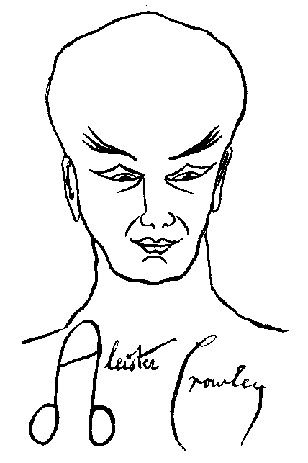
Aleister Crowley Aleister Crowley, born Edward Alexander Crowley, (12 October 1875 - 1 December 1947) was an English occultist, prolific writer and poet, mystic, astrologer, drug experimenter, hedonist, aficionado of chess and mountain climbing, sexual revolutionary and social critic. He is perhaps best known today for his occult writings, especially The Book of the Law, the central sacred text of Thelema. Crowley was also an influential member in several occult organizations, including the Golden Dawn, the Argenteum Astrum, and Ordo Templi Orientis (O.T.O.). Crowley gained much notoriety during his lifetime, and was famously dubbed "The Wickedest Man In the World."

Aleister Crowley founded the religion of Thelema, which became adopted by the Ordo Templis Orientis (O.T.O.) as well as the magical order Argenteum Astrum, the Order of the Silver Star. He was also a highly controversial member of the Hermetic Order of the Golden Dawn, where he was known by the magical name of Frater Perdurabo.

Crowley's lifestyle was absolutely shocking in the era in which he lived. Besides his interest in the occult, he was sexually promiscuous with both genders (at a time when homosexuality was still illegal in Britain), frequented prostitutes, was vocally defiant against Christianity and Victorian and post-Victorian prudishness toward sexual subjects, and was a drug addict.

While Crowley detested Christianity, he considered himself an immensely religious and spiritual person. His writings record incidents of experiencing deity, and Thelemites consider him to be a prophet. In 1904, he encountered a being known as Aiwass, described as a "minister" to Horus, the central deity in Thelema, and as a Holy Guardian Angel. Aiwass dictated the Book of the Law, which Crowley wrote down and published, becoming the central Thelemic text.

Crowley's beliefs included pursuing the Great Work, which included gaining self-knowledge and uniting with the larger universe. He also encouraged seeking out one's ultimate destiny or purpose, commonly referred to as one's True Will.
Christina DebesCurated by Christina Debes since 2008
KEEP THE LIBRARY FREE

Choose the kind of support that works for you

Individual public-domain books remain free. Paid options provide convenient ZIP archives and help cover hosting, storage, research and preservation.

ONE-TIME

Starter Archive

$12

The Magic Catalog #1 in one curated ZIP file. A simple way to try the archive format.

Get the starter archive
ONGOING SUPPORT

Become a Member

from $5/month

Choose Library Keeper, Archivist or Grand Curator for updates, archive access and a voice in future collections.

See membership levels

Prefer individual books? Continue browsing and downloading them free of charge. Membership is support, not a paywall for the public library.

Make a direct cryptocurrency donation
Bitcoin (BTC network)15Kz1Zuq9FHugjCc3Xamdikdu6irQUHdqG
Ethereum (ETH / ERC-20)0x90c9d66cd07efa5c413551cfd5c2ce03c986b143

The same shelf

More books beside this one

Most taken from the archive
  • 50 Of The Most Powerful Spells On The Face Of Earth
  • Basic Techniques of Sex Magick
  • Book Of Spells
  • Black Book of Forbidden Knowledge Lucid Dreaming
  • The Book Of Shadows
  • The Book Of Secrets
  • Control of The Astral Body
  • White Magic Spells
  • The Book Of Raziel The Angel Or Sefer Raziel HaMalakh
  • The Book Of Thoth
  • Magick In Theory And Practice
  • The Darkside Of The Moon A Complete Course In Magic And Witchcraft

Looking for a book that is not here? It may be in my home library: write to the curator's email and I will try to help — I can send the book by email.