Skip to the archive
Individual books remain freeHelp preserve the shelves
From the archive · Aleister Crowley's Books Catalog

Stone of Cybele from Golden Twigs

by Aleister Crowley

Cover of Stone of Cybele from Golden Twigs by Aleister Crowley

taken from the archive687times

Cotys is driven by the responsibility of inheriting a sacred stone of Cybele, an occult relic passed down through her family. The author details her task to retrieve the stone from a hidden safe in her father's library, emphasizing the mystical significance of the heirloom. This inheritance is tied to her lineage as part of the Flacci, a lineage connected to ancient traditions. The stone, taken during the sack of… Read on ›

AuthorAll books of Aleister Crowley · Biography · Images
FormateBook, 75.0 Kb
ShelvesThelema Magick

The whole Aleister Crowley's Books Catalog in one ZIP

DarkBooks is a living archive of magical literature, kept since 2008 by its curator and by the readers who support it. Readers have taken 1.9 million books from it — and every one of them stays free. Become one of the keepers ›

About the book

Cotys is driven by the responsibility of inheriting a sacred stone of Cybele, an occult relic passed down through her family. The author details her task to retrieve the stone from a hidden safe in her father's library, emphasizing the mystical significance of the heirloom. This inheritance is tied to her lineage as part of the Flacci, a lineage connected to ancient traditions. The stone, taken during the sack of Rome by Genseric, is a symbol of her family's legacy and the continuity of their mystical heritage. The author presents this as a central plot point, highlighting the intersection of personal loss and ancestral duty. Cotys must navigate both the practical and the supernatural aspects of this inheritance, reflecting the blend of historical and occult themes in the narrative.

Her invocation of a mysterious language, charged with 'lightnings' and 'hissing,' reflects the text's focus on the occult significance of inherited divine roles. The author portrays Cotys's experience as a physical and spiritual metamorphosis, where her connection to the old gods manifests through ritualistic acts and symbolic gestures. The author suggests that ancient beliefs and practices hold enduring influence over human consciousness, as evidenced by Cotys's ability to channel primal forces through her devotion to Cybele. The author's depiction of her ritualistic communion with the past underscores the idea that spiritual identity is inextricably linked to ancestral heritage and ancient mysteries.

The author describes the ritual's climax, where Regulus, under the influence of the ceremony, repeats the incantation 'Soi d'egq leukas epi bqmon aigos.' This line, a critical element of the ritual, signifies the offering of a white goat's offspring to the goddess, marking the completion of the sacred rite.

In the dimly lit studio, the stone of Cybele, jet black and shaped like a sugar-loaf, is central to the narrative. Its presence evokes a sense of ancient mystery, as Cotys and Claude engage in a ritualistic exchange around its significance. The stone, set in a plain stand of gold with the inscription 'Ave Mater Deorum,' becomes a conduit for supernatural experiences, prompting Cotys to recall a vivid vision involving torches, cymbals, and a mysterious figure. The author emphasizes the stone's role in a ritual that blends historical and occult elements, with Cotys's physical reaction to it??"feeling it become hot and experiencing a fleeting vision??"highlighting its perceived mystical power. This object serves as a focal point for the story's exploration of heritage, duty, and the intersection of the past with the present.

In the heart of ancient Pergamon, the sacred stone of Cybele stands as a symbol of the clash between pagan worship and Christian influence. The author depicts Cotys' trance state, where she loses awareness of her surroundings, highlighting the power of the sacred object to transcend rational understanding. Her confusion upon waking underscores the lingering effects of the ritual, suggesting the stone's ability to awaken deep-seated cultural and religious memories. The author's portrayal of Cotys' experience reflects a broader theme of the clash between traditional pagan beliefs and Christian faith, with the stone serving as a focal point of this spiritual conflict.

Not every book of the collection can be downloaded because of copyright, although most of them have no such restrictions. If you find a copyright violation, please write to the curator's email: I am attentive to copyright and try to avoid any violation, while helping all who study magic to reach its literature.

About the author

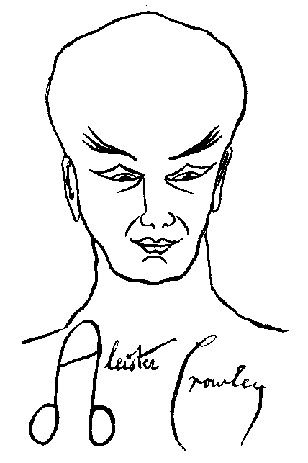
Aleister Crowley Aleister Crowley, born Edward Alexander Crowley, (12 October 1875 - 1 December 1947) was an English occultist, prolific writer and poet, mystic, astrologer, drug experimenter, hedonist, aficionado of chess and mountain climbing, sexual revolutionary and social critic. He is perhaps best known today for his occult writings, especially The Book of the Law, the central sacred text of Thelema. Crowley was also an influential member in several occult organizations, including the Golden Dawn, the Argenteum Astrum, and Ordo Templi Orientis (O.T.O.). Crowley gained much notoriety during his lifetime, and was famously dubbed "The Wickedest Man In the World."

Aleister Crowley founded the religion of Thelema, which became adopted by the Ordo Templis Orientis (O.T.O.) as well as the magical order Argenteum Astrum, the Order of the Silver Star. He was also a highly controversial member of the Hermetic Order of the Golden Dawn, where he was known by the magical name of Frater Perdurabo.

Crowley's lifestyle was absolutely shocking in the era in which he lived. Besides his interest in the occult, he was sexually promiscuous with both genders (at a time when homosexuality was still illegal in Britain), frequented prostitutes, was vocally defiant against Christianity and Victorian and post-Victorian prudishness toward sexual subjects, and was a drug addict.

While Crowley detested Christianity, he considered himself an immensely religious and spiritual person. His writings record incidents of experiencing deity, and Thelemites consider him to be a prophet. In 1904, he encountered a being known as Aiwass, described as a "minister" to Horus, the central deity in Thelema, and as a Holy Guardian Angel. Aiwass dictated the Book of the Law, which Crowley wrote down and published, becoming the central Thelemic text.

Crowley's beliefs included pursuing the Great Work, which included gaining self-knowledge and uniting with the larger universe. He also encouraged seeking out one's ultimate destiny or purpose, commonly referred to as one's True Will.
Christina DebesCurated by Christina Debes since 2008
KEEP THE LIBRARY FREE

Choose the kind of support that works for you

Individual public-domain books remain free. Paid options provide convenient ZIP archives and help cover hosting, storage, research and preservation.

ONE-TIME

Starter Archive

$12

The Magic Catalog #1 in one curated ZIP file. A simple way to try the archive format.

Get the starter archive
ONGOING SUPPORT

Become a Member

from $5/month

Choose Library Keeper, Archivist or Grand Curator for updates, archive access and a voice in future collections.

See membership levels

Prefer individual books? Continue browsing and downloading them free of charge. Membership is support, not a paywall for the public library.

Make a direct cryptocurrency donation
Bitcoin (BTC network)15Kz1Zuq9FHugjCc3Xamdikdu6irQUHdqG
Ethereum (ETH / ERC-20)0x90c9d66cd07efa5c413551cfd5c2ce03c986b143

The same shelf

More books beside this one

Most taken from the archive
  • 50 Of The Most Powerful Spells On The Face Of Earth
  • Basic Techniques of Sex Magick
  • Book Of Spells
  • Black Book of Forbidden Knowledge Lucid Dreaming
  • The Book Of Shadows
  • The Book Of Secrets
  • Control of The Astral Body
  • White Magic Spells
  • The Book Of Raziel The Angel Or Sefer Raziel HaMalakh
  • The Book Of Thoth
  • Magick In Theory And Practice
  • The Darkside Of The Moon A Complete Course In Magic And Witchcraft

Looking for a book that is not here? It may be in my home library: write to the curator's email and I will try to help — I can send the book by email.