Skip to the archive
Individual books remain freeHelp preserve the shelves
From the archive · Aleister Crowley's Books Catalog

Liber 220 Al vel Legis The Book Of The Law

by Aleister Crowley

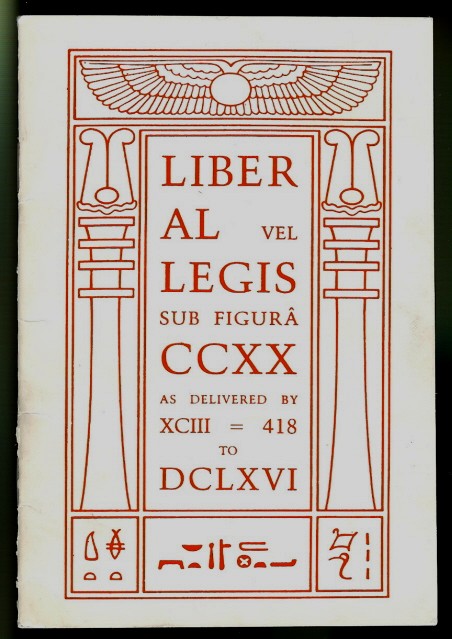
Cover of Liber 220 Al vel Legis The Book Of The Law by Aleister Crowley

taken from the archive625times

This phrase implies a universe where individual will is the ultimate law, transcending traditional notions of morality or divine command. The author presents this as a fundamental tenet of the text, suggesting that obedience to this principle is the essence of the Law. This idea is reinforced by the text's prohibition against discussing its contents, indicating that the mystery is meant to be experienced rather than… Read on ›

AuthorAll books of Aleister Crowley · Biography · Images
FormateBook, 219.0 Kb
ShelvesThelema Magick

The whole Aleister Crowley's Books Catalog in one ZIP

DarkBooks is a living archive of magical literature, kept since 2008 by its curator and by the readers who support it. Readers have taken 1.9 million books from it — and every one of them stays free. Become one of the keepers ›

About the book

This phrase implies a universe where individual will is the ultimate law, transcending traditional notions of morality or divine command. The author presents this as a fundamental tenet of the text, suggesting that obedience to this principle is the essence of the Law. This idea is reinforced by the text's prohibition against discussing its contents, indicating that the mystery is meant to be experienced rather than explained. The text also emphasizes the importance of secrecy and the danger of questioning its teachings, further highlighting the enigmatic nature of the Law.

Thetext describes a ritualistic celebration of life and ecstasy, emphasizing the importance of joy and beauty in ceremonies. It mentions specific feasts dedicated to various deities and events, such as the 'feast for the first night of the Prophet and his Bride' and the 'Supreme Ritual.' The author suggests that these rituals should be conducted with fervor and delight, reflecting a worldview where spiritual and physical pleasures are intertwined. The text also highlights a paradoxical attitude towards suffering, advocating for the suppression of the weak and the embrace of sensory experiences, which underscores a unique blend of ecstatic celebration and a harsh judgment of the marginalized.

In the late 19th century, a mysterious text emerged from the occult circles of France, revealing a philosophy that challenged traditional religious doctrines. The author, known as 'Liber 220 Al vel Legis,' presents a worldview where individual will is supreme, with the assertion that 'There is no law beyond Do what thou wilt.' This declaration underscores a radical rejection of established moral codes, advocating instead for a path defined by personal desire and action. The text's intense imagery and violent metaphors reflect a fervent celebration of human agency, suggesting that true freedom lies in the unbridled expression of one's will, even if it means defying divine or societal laws.

Theauthor asserts that aligning with one's will leads to absolute freedom, as no external force can oppose it. This is encapsulated in the passage 'Do that, and no other shall say nay,' which emphasizes that true obedience to one's will is unchallengeable. It suggests that when one acts in accordance with their inner desires, they are not only following a divine command but also achieving a state of ecstatic unity with the cosmos. The passage reflects an occult philosophy that prioritizes personal autonomy and the dissolution of conventional boundaries, offering a radical perspective on freedom and existence.

Theauthor specifies the creation and placement of a specific image, describing it as a crucial ritual element. The passage mentions 'set up my image in the East' and refers to acquiring an 'image which I will show thee, especial, not unlike the one thou knowest,' indicating a detailed procedure for establishing a symbolic representation. This act is tied to the broader context of conquest and divine worship, suggesting the image serves as both a spiritual and tactical focal point. The emphasis on the image's importance reflects the text's focus on ritual and symbolic actions as central to its esoteric teachings.

Not every book of the collection can be downloaded because of copyright, although most of them have no such restrictions. If you find a copyright violation, please write to the curator's email: I am attentive to copyright and try to avoid any violation, while helping all who study magic to reach its literature.

About the author

Aleister Crowley Aleister Crowley, born Edward Alexander Crowley, (12 October 1875 - 1 December 1947) was an English occultist, prolific writer and poet, mystic, astrologer, drug experimenter, hedonist, aficionado of chess and mountain climbing, sexual revolutionary and social critic. He is perhaps best known today for his occult writings, especially The Book of the Law, the central sacred text of Thelema. Crowley was also an influential member in several occult organizations, including the Golden Dawn, the Argenteum Astrum, and Ordo Templi Orientis (O.T.O.). Crowley gained much notoriety during his lifetime, and was famously dubbed "The Wickedest Man In the World."

Aleister Crowley founded the religion of Thelema, which became adopted by the Ordo Templis Orientis (O.T.O.) as well as the magical order Argenteum Astrum, the Order of the Silver Star. He was also a highly controversial member of the Hermetic Order of the Golden Dawn, where he was known by the magical name of Frater Perdurabo.

Crowley's lifestyle was absolutely shocking in the era in which he lived. Besides his interest in the occult, he was sexually promiscuous with both genders (at a time when homosexuality was still illegal in Britain), frequented prostitutes, was vocally defiant against Christianity and Victorian and post-Victorian prudishness toward sexual subjects, and was a drug addict.

While Crowley detested Christianity, he considered himself an immensely religious and spiritual person. His writings record incidents of experiencing deity, and Thelemites consider him to be a prophet. In 1904, he encountered a being known as Aiwass, described as a "minister" to Horus, the central deity in Thelema, and as a Holy Guardian Angel. Aiwass dictated the Book of the Law, which Crowley wrote down and published, becoming the central Thelemic text.

Crowley's beliefs included pursuing the Great Work, which included gaining self-knowledge and uniting with the larger universe. He also encouraged seeking out one's ultimate destiny or purpose, commonly referred to as one's True Will.
Christina DebesCurated by Christina Debes since 2008
KEEP THE LIBRARY FREE

Choose the kind of support that works for you

Individual public-domain books remain free. Paid options provide convenient ZIP archives and help cover hosting, storage, research and preservation.

ONE-TIME

Starter Archive

$12

The Magic Catalog #1 in one curated ZIP file. A simple way to try the archive format.

Get the starter archive
ONGOING SUPPORT

Become a Member

from $5/month

Choose Library Keeper, Archivist or Grand Curator for updates, archive access and a voice in future collections.

See membership levels

Prefer individual books? Continue browsing and downloading them free of charge. Membership is support, not a paywall for the public library.

Make a direct cryptocurrency donation
Bitcoin (BTC network)15Kz1Zuq9FHugjCc3Xamdikdu6irQUHdqG
Ethereum (ETH / ERC-20)0x90c9d66cd07efa5c413551cfd5c2ce03c986b143

The same shelf

More books beside this one

Most taken from the archive
  • 50 Of The Most Powerful Spells On The Face Of Earth
  • Basic Techniques of Sex Magick
  • Book Of Spells
  • Black Book of Forbidden Knowledge Lucid Dreaming
  • The Book Of Shadows
  • The Book Of Secrets
  • Control of The Astral Body
  • White Magic Spells
  • The Book Of Raziel The Angel Or Sefer Raziel HaMalakh
  • The Book Of Thoth
  • Magick In Theory And Practice
  • The Darkside Of The Moon A Complete Course In Magic And Witchcraft

Looking for a book that is not here? It may be in my home library: write to the curator's email and I will try to help — I can send the book by email.