Skip to the archive
Individual books remain freeHelp preserve the shelves
From the archive · Witchcraft And Wicca Books Catalog #2

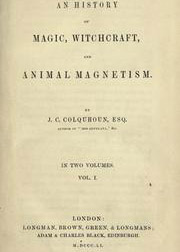
An History of Magic Witchcraft and Animal Magnetism

by John Campbell Colquhoun

Cover of An History of Magic Witchcraft and Animal Magnetism by John Campbell Colquhoun

taken from the archive2,518times

In the early 19th century, the study of Animal Magnetism faced significant skepticism and opposition. A German physician's discovery, though initially met with ridicule and denunciation as a heresy, eventually gained recognition. The author notes that this discovery, though controversial, was crucial in expanding scientific understanding of human constitution. The author's account highlights the historical context… Read on ›

AuthorAll books of John Campbell Colquhoun · Biography
FormateBook, 33.2 MB
ShelvesWicca and Witchcraft

The whole Witchcraft And Wicca Books Catalog #2 in one ZIP

DarkBooks is a living archive of magical literature, kept since 2008 by its curator and by the readers who support it. Readers have taken 1.9 million books from it — and every one of them stays free. Become one of the keepers ›

About the book

In the early 19th century, the study of Animal Magnetism faced significant skepticism and opposition. A German physician's discovery, though initially met with ridicule and denunciation as a heresy, eventually gained recognition. The author notes that this discovery, though controversial, was crucial in expanding scientific understanding of human constitution. The author's account highlights the historical context where scientific inquiry into phenomena like Animal Magnetism was often dismissed, yet the persistence of researchers led to its eventual acceptance. The author emphasizes the importance of distinguishing between valid scientific inquiry and superstition, advocating for a broader definition of science that includes psychological and moral aspects.

In ancient times, MAGIC was deeply embedded in the spiritual and intellectual lives of various cultures, including the Chaldeans, Persians, and Hindus. The author describes how MAGIC was intertwined with their physical and intellectual philosophy, combining religious worship with ceremonial practices. This is evident in the construction of the Jewish Temple and the Vedas, which contained theological notions, philosophical doctrines, and references to magical states of the soul. The author notes that these ancient texts were initially viewed as mystical fables but later understood through the lens of physiology and Animal Magnetism, revealing a connection between ancient spiritual experiences and modern scientific phenomena.

The author notes that the Papal bull of Innocent VIII. authorized Inquisitors to prosecute witches and sorcerers without appeal, establishing a framework where any doubt about witchcraft could be seen as supporting diabolical arts. This is evidenced by the passage stating that even questioning the reality of witchcraft was enough to suspect someone of patronizing diabolical practices, highlighting the intolerance and arbitrary enforcement of these new legal standards.

In the 20th century, the author raises the central mystery of the nature of existence and the conflict between theistic and atheistic worldviews. The author argues that the Freethinker's rejection of a divine creator in favor of natural laws is a mere substitution of terms, as Nature and Necessity are not sufficient explanations for the complexity of the universe. The author contends that the Freethinker's argument is a form of blasphemy, as it dismisses the need for a Creator and His eternal laws, suggesting that the universe is self-sufficient without a higher power.

Theauthor highlights the ancient Greek oracles as a central focus, noting their widespread consultation even by the most educated. These oracles, despite being criticized by modern authors as fraudulent, were once highly regarded, with responses often ambiguous yet seemingly accurate. The author suggests that these oracles, through their enigmatic answers, provided insights that were not merely delusions but reflected a deep understanding of human affairs and the future. One notable example is the trial of King Croesus, where an oracle correctly predicted his fate through a clever test, demonstrating a level of foresight that challenged contemporary skepticism.

Not every book of the collection can be downloaded because of copyright, although most of them have no such restrictions. If you find a copyright violation, please write to the curator's email: I am attentive to copyright and try to avoid any violation, while helping all who study magic to reach its literature.

About the author

John Campbell Colquhoun was born on January 23, 1803, in Edinburgh, Scotland. He was the son of Archibald Colquhoun and Mary Ann, daughter of the Rev. William Erskine, an episcopal minister at Muthill, Perthshire. He received his education at Edinburgh High School and later enrolled at Oriel College, Oxford.

In 1832, Colquhoun was elected as a Member of Parliament for Dumbartonshire, and in 1837, he was elected for Kilmarnock Burghs. He unsuccessfully contested the Kilmarnock burghs in July 1841 but was elected in July 1842 as a member for Newcastle-under-Lyme, where he continued to represent until the dissolution of 1847, when he retired due to health reasons.

He was a wealthy Conservative and evangelical figure. He served as the president of the Glasgow Society and was chairman of the general committee of the National Club, the Church of England Education Society, and the Irish Church Mission to Roman Catholics. His political career was marked by his dedication to these causes.

His life was intertwined with various esoteric and magical traditions. He was deeply influenced by the teachings of the Scottish Enlightenment, particularly those of the 18th-century philosopher Francis Hutcheson, who emphasized the importance of virtue and moral conduct. This influence is evident in his later writings, which often reflect a blend of Christian ethics and a more esoteric understanding of the universe.

His interest in magic and witchcraft was not isolated but was part of a broader intellectual curiosity. He was drawn to the works of figures such as John Dee, who was known for his work on alchemy and magic, and John Dee's contemporaries like Sir Walter Raleigh and Sir Francis Bacon. These works provided Colquhoun with a framework for understanding the natural world and the role of human agency in shaping it.

His esoteric teachings were deeply rooted in the principles of magic and witchcraft. He was particularly interested in the works of John Dee, who was known for his alchemical experiments and his work on the occult. Colquhoun's approach to magic was characterized by a belief in the power of the individual to influence the natural world through their actions and understanding.

His magickal system was based on the principles of natural law and the use of spiritual forces to achieve desired outcomes. He believed in the existence of a higher power or force that could be tapped into through proper knowledge and practice. Colquhoun's teachings were not just theoretical but were grounded in practical rituals and exercises designed to enhance one's spiritual and magical abilities.

His legacy is significant in the context of Western esotericism and occultism. His writings reflect a blend of Christian ethics and a more esoteric understanding of the universe. He was a proponent of the idea that human agency could shape the natural world through proper knowledge and practice.

His influence can be seen in the works of later esotericists and occultists who built upon his ideas. His teachings were not just theoretical but were grounded in practical rituals and exercises designed to enhance one's spiritual and magical abilities. His approach to magic was not just theoretical but was grounded in a belief in the power of the individual to influence the natural world through their actions and understanding.
Christina DebesCurated by Christina Debes since 2008
KEEP THE LIBRARY FREE

Choose the kind of support that works for you

Individual public-domain books remain free. Paid options provide convenient ZIP archives and help cover hosting, storage, research and preservation.

ONE-TIME

Starter Archive

$12

The Magic Catalog #1 in one curated ZIP file. A simple way to try the archive format.

Get the starter archive
ONGOING SUPPORT

Become a Member

from $5/month

Choose Library Keeper, Archivist or Grand Curator for updates, archive access and a voice in future collections.

See membership levels

Prefer individual books? Continue browsing and downloading them free of charge. Membership is support, not a paywall for the public library.

Make a direct cryptocurrency donation
Bitcoin (BTC network)15Kz1Zuq9FHugjCc3Xamdikdu6irQUHdqG
Ethereum (ETH / ERC-20)0x90c9d66cd07efa5c413551cfd5c2ce03c986b143
The same shelf

More books beside this one

Most taken from the archive
  • 50 Of The Most Powerful Spells On The Face Of Earth
  • Basic Techniques of Sex Magick
  • Book Of Spells
  • Black Book of Forbidden Knowledge Lucid Dreaming
  • The Book Of Shadows
  • The Book Of Secrets
  • Control of The Astral Body
  • White Magic Spells
  • The Book Of Raziel The Angel Or Sefer Raziel HaMalakh
  • The Book Of Thoth
  • Magick In Theory And Practice
  • The Darkside Of The Moon A Complete Course In Magic And Witchcraft

Looking for a book that is not here? It may be in my home library: write to the curator's email and I will try to help — I can send the book by email.