Skip to the archive
Individual books remain freeHelp preserve the shelves
From the archive · Howard Phillips Lovecraft Books Catalog

Celephais

by Howard Phillips Lovecraft

Cover of Celephais by Howard Phillips Lovecraft

taken from the archive183times

Theauthor describes Kuranes as the last of his family, alone in London amidst the indifferent millions. This isolation fuels his retreat into dreams and writing, where he seeks beauty and wonder in a world that has forgotten such things. His dreams reveal a lost world of enchantment, suggesting a deeper existential search for meaning in a universe that has become dull and unremarkable. The author's portrayal of… Read on ›

AuthorAll books of Howard Phillips Lovecraft · Biography · Images
FormateBook, 76.0 Kb
ShelvesHorror Tales

The whole Howard Phillips Lovecraft Books Catalog in one ZIP

DarkBooks is a living archive of magical literature, kept since 2008 by its curator and by the readers who support it. Readers have taken 1.9 million books from it — and every one of them stays free. Become one of the keepers ›

About the book

Theauthor describes Kuranes as the last of his family, alone in London amidst the indifferent millions. This isolation fuels his retreat into dreams and writing, where he seeks beauty and wonder in a world that has forgotten such things. His dreams reveal a lost world of enchantment, suggesting a deeper existential search for meaning in a universe that has become dull and unremarkable. The author's portrayal of Kuranes' isolation and his yearning for a bygone era of wonder highlights a fundamental question about the human condition: how do we find significance in a universe that seems indifferent and vast? The passage underscores the tension between the mundane reality of modern life and the enduring allure of forgotten, fantastical realms.

Kuranes encounters the abyss of dreams, a seething chaos of roseate and cerulean splendour, as he and his entourage plunge over the edge. The abyss is described as a place of vivid, otherworldly beauty, with invisible voices singing exultantly. This surreal and fantastical setting reflects the book's exploration of dreams and the supernatural, emphasizing the mysterious and eerie nature of the dream realm.

He discovers a fantastical city, Celephais, after forty years of searching, having dreamed of it since childhood. The author argues that Kuranes's journey is a metaphor for the search for lost innocence and eternal youth, as he finds the city of his youth, where time does not pass and everything remains as it was.

This vivid imagery reflects the book's exploration of the supernatural and the occult, illustrating the transition from the mundane to the fantastical. The author argues that this scene symbolizes the entry into a realm beyond human understanding, where the boundaries of reality blur and the extraordinary becomes the norm.

The author's depiction of the sentries on the ramparts as 'the same, and still as young as he remembered them' underscores the eternal nature of Celephais, a place where time does not pass and where the past, present, and future converge in an unchanging, eternal moment.

Theauthor portrays Kuranes as a creator of dreams, elevated to godhood for his role in shaping Ooth-Nargai. This challenges the common assumption that gods are external forces, instead positioning Kuranes as a human being who becomes divine through his creative power. The passage states that Kuranes 'was now to be appointed its chief god for evermore,' highlighting the book's myth that human imagination and consciousness can transcend mortality and achieve divinity. This aligns with occult claims that the mind holds the power to create and sustain realms beyond the physical world, suggesting that the boundary between reality and fantasy is more fluid than traditionally believed.

The(author) implies an audience familiar with the literary traditions of the late 19th and early 20th centuries, particularly those engaged with the works of H.P. Lovecraft. The author suggests a readership that would recognize the influence of cosmic horror and the 'Cthulhu Mythos,' as well as the broader themes of existential insignificance and the limits of human comprehension. The passage contrasts Kuranes' approach to writing with that of his contemporaries, indicating an understanding of the literary landscape in which he moved.

Not every book of the collection can be downloaded because of copyright, although most of them have no such restrictions. If you find a copyright violation, please write to the curator's email: I am attentive to copyright and try to avoid any violation, while helping all who study magic to reach its literature.

About the author

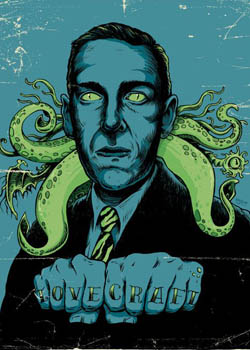
Howard Phillips Lovecraft Howard Phillips Lovecraft (August 20, 1890 ??" March 15, 1937) was an American author of horror, fantasy, and science fiction, known then simply as weird fiction.

HP Lovecraft was one of the early exponents of horror fantasy, best known for the series of works known collectively as the Cthulhu Mythos. He peppered his books with references to an occult work called The Necronomicon, and, as his fame grew, he was besieged by readers asking where they could find a copy of it. But the truth was that Lovecraft had invented the book and its title. He wrote in a letter of 1937: ??The name Necronomicon (necros, corpse; nomos, law; eikon, image = An Image of the Law of the Dead) occurred to me in the course of a dream, although the etymology is perfectly sound.??(TM) So the title came before everything else, and substituted, perfectly reasonably, for the work itself.

This is a game that many writers have played, and the history of literature is full of references to books that don??(TM)t, in fact, exist. Margaret Atwood, AS Byatt, Dorothy L Sayers, Frank Herbert, Martin Amis, Arthur Conan Doyle and many, many others have all joined in. Some of my favourite fictional titles are from Kurt Vonnegut, who, as Kilgore Trout, writes non-existent works such as The Barring-Gaffner of Bagnialto, or This Year's Masterpiece, which are usually accompanied by helpful plot summaries. Perhaps the most notorious fictional-book-inventors have been writers such as Umberto Eco and Jorge Luis Borges; naturally enough, since their writing often draws attention to literature as itself an artefact.

With the Necronomicon there was a difference, however. Other writers began to treat it as if it really did exist, quoting from the nonexistent work and even composing large sections of it; several Necronomicons were in fact later published, by hoaxers including L. Sprague De Camp and Colin Wilson.

Lovecraft's major inspiration and invention was cosmic horror, the idea that life is incomprehensible to human minds and that the universe is fundamentally alien. Those who genuinely reason, like his protagonists, gamble with sanity. Lovecraft has developed a cult following for his Cthulhu Mythos, a series of loosely interconnected fiction featuring a pantheon of human-nullifying entities, as well as the Necronomicon, a fictional grimoire of magical rites and forbidden lore. His works were deeply pessimistic and cynical, challenging the values of the Enlightenment, Romanticism, and Christian humanism. Lovecraft's protagonists usually achieve the mirror-opposite of traditional gnosis and mysticism by momentarily glimpsing the horror of ultimate reality.

Although Lovecraft's readership was limited during his life, his reputation has grown over the decades, and he is now commonly regarded as one of the most influential horror writers of the 20th century, who together with Edgar Allan Poe has exerted "an incalculable influence on succeeding generations of writers of horror fiction". Stephen King has called Lovecraft "the twentieth century's greatest practitioner of the classic horror tale.
Christina DebesCurated by Christina Debes since 2008
KEEP THE LIBRARY FREE

Choose the kind of support that works for you

Individual public-domain books remain free. Paid options provide convenient ZIP archives and help cover hosting, storage, research and preservation.

ONE-TIME

Starter Archive

$12

The Magic Catalog #1 in one curated ZIP file. A simple way to try the archive format.

Get the starter archive
ONGOING SUPPORT

Become a Member

from $5/month

Choose Library Keeper, Archivist or Grand Curator for updates, archive access and a voice in future collections.

See membership levels

Prefer individual books? Continue browsing and downloading them free of charge. Membership is support, not a paywall for the public library.

Make a direct cryptocurrency donation
Bitcoin (BTC network)15Kz1Zuq9FHugjCc3Xamdikdu6irQUHdqG
Ethereum (ETH / ERC-20)0x90c9d66cd07efa5c413551cfd5c2ce03c986b143
The same shelf

More books beside this one

Most taken from the archive
  • 50 Of The Most Powerful Spells On The Face Of Earth
  • Basic Techniques of Sex Magick
  • Book Of Spells
  • Black Book of Forbidden Knowledge Lucid Dreaming
  • The Book Of Shadows
  • The Book Of Secrets
  • Control of The Astral Body
  • White Magic Spells
  • The Book Of Raziel The Angel Or Sefer Raziel HaMalakh
  • The Book Of Thoth
  • Magick In Theory And Practice
  • The Darkside Of The Moon A Complete Course In Magic And Witchcraft

Looking for a book that is not here? It may be in my home library: write to the curator's email and I will try to help — I can send the book by email.