Skip to the archive
Individual books remain freeHelp preserve the shelves
From the archive · Aleister Crowley's Books Catalog

Clouds Without Water

by Aleister Crowley

Cover of Clouds Without Water by Aleister Crowley

taken from the archive822times

Theauthor claims that the individuals who wrote the blasphemous and obscene content in the book have received the recompense of their error. This is evident in the preface where the author states, 'Receiving in themselves that recompense of their error which was meet.' The author suggests that the writer of the controversial material has been punished for their actions, highlighting a belief in divine retribution.… Read on ›

AuthorAll books of Aleister Crowley · Biography · Images
FormateBook, 2.4 MB
ShelvesThelema Magick

The whole Aleister Crowley's Books Catalog in one ZIP

DarkBooks is a living archive of magical literature, kept since 2008 by its curator and by the readers who support it. Readers have taken 1.9 million books from it — and every one of them stays free. Become one of the keepers ›

About the book

Theauthor claims that the individuals who wrote the blasphemous and obscene content in the book have received the recompense of their error. This is evident in the preface where the author states, 'Receiving in themselves that recompense of their error which was meet.' The author suggests that the writer of the controversial material has been punished for their actions, highlighting a belief in divine retribution. This is a significant claim as it implies that the author believes in the moral consequences of one's actions, even in the context of spiritual or occult themes.

In the late 19th century, the author describes a surreal encounter with fleeting, fragile deities, lamenting their ephemeral nature. The passage reflects a deep existential crisis, where the creator feels disconnected from their own creations, highlighting the tension between divine ambition and human limitation. The author's struggle to grasp permanence in a world of transient forms underscores a philosophical exploration of existence and the futility of attempting to impose order on chaos.

In the passage, the author declares 'We love each other ! let them meditate' highlighting the sacred and transformative power of their bond, which is seen as a divine revelation capable of altering the very fabric of existence. This declaration underscores the central theme of the text, where love is not merely an emotional experience but a cosmic force that connects the lovers to higher realms of existence, challenging traditional notions of divinity and human spirituality.

The author presents a group of figures who reject conventional morality, finding pleasure in transgression without regard for consequences. This is evident in the passage where the author states, 'We are still young enough to take delight In wickedness for wickedness' sole sake.' The author suggests that these individuals are part of a movement that glorifies immoral behavior, viewing it as a form of spiritual or existential freedom. The author portrays them as part of a larger societal trend, linking their actions to the broader cultural and philosophical shifts of the time.

Theauthor describes a ritual of ecstatic union, where the speaker is transformed into a symbol of intense desire and spiritual connection. The passage details a vision of the speaker as an aching mouth, parched with bliss, with lips curled back and breath desiring the other person. This imagery reflects a profound, almost supernatural experience of love and unity, where the self is dissolved into a state of ecstatic fusion. The ritual involves a sacred exchange of passion and spirituality, with the speaker becoming a vessel for the other's desires and the two merging in a transcendental moment. The author's portrayal of this ritual emphasizes the intensity and otherworldly nature of the experience, suggesting a deeper, almost mystical connection between the participants.

Not every book of the collection can be downloaded because of copyright, although most of them have no such restrictions. If you find a copyright violation, please write to the curator's email: I am attentive to copyright and try to avoid any violation, while helping all who study magic to reach its literature.

About the author

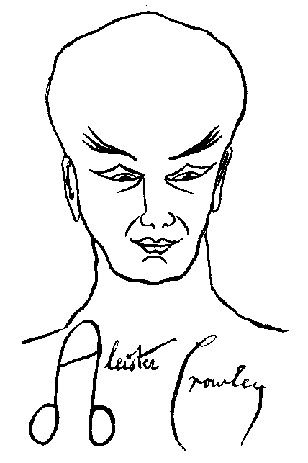
Aleister Crowley Aleister Crowley, born Edward Alexander Crowley, (12 October 1875 - 1 December 1947) was an English occultist, prolific writer and poet, mystic, astrologer, drug experimenter, hedonist, aficionado of chess and mountain climbing, sexual revolutionary and social critic. He is perhaps best known today for his occult writings, especially The Book of the Law, the central sacred text of Thelema. Crowley was also an influential member in several occult organizations, including the Golden Dawn, the Argenteum Astrum, and Ordo Templi Orientis (O.T.O.). Crowley gained much notoriety during his lifetime, and was famously dubbed "The Wickedest Man In the World."

Aleister Crowley founded the religion of Thelema, which became adopted by the Ordo Templis Orientis (O.T.O.) as well as the magical order Argenteum Astrum, the Order of the Silver Star. He was also a highly controversial member of the Hermetic Order of the Golden Dawn, where he was known by the magical name of Frater Perdurabo.

Crowley's lifestyle was absolutely shocking in the era in which he lived. Besides his interest in the occult, he was sexually promiscuous with both genders (at a time when homosexuality was still illegal in Britain), frequented prostitutes, was vocally defiant against Christianity and Victorian and post-Victorian prudishness toward sexual subjects, and was a drug addict.

While Crowley detested Christianity, he considered himself an immensely religious and spiritual person. His writings record incidents of experiencing deity, and Thelemites consider him to be a prophet. In 1904, he encountered a being known as Aiwass, described as a "minister" to Horus, the central deity in Thelema, and as a Holy Guardian Angel. Aiwass dictated the Book of the Law, which Crowley wrote down and published, becoming the central Thelemic text.

Crowley's beliefs included pursuing the Great Work, which included gaining self-knowledge and uniting with the larger universe. He also encouraged seeking out one's ultimate destiny or purpose, commonly referred to as one's True Will.
Christina DebesCurated by Christina Debes since 2008
KEEP THE LIBRARY FREE

Choose the kind of support that works for you

Individual public-domain books remain free. Paid options provide convenient ZIP archives and help cover hosting, storage, research and preservation.

ONE-TIME

Starter Archive

$12

The Magic Catalog #1 in one curated ZIP file. A simple way to try the archive format.

Get the starter archive
ONGOING SUPPORT

Become a Member

from $5/month

Choose Library Keeper, Archivist or Grand Curator for updates, archive access and a voice in future collections.

See membership levels

Prefer individual books? Continue browsing and downloading them free of charge. Membership is support, not a paywall for the public library.

Make a direct cryptocurrency donation
Bitcoin (BTC network)15Kz1Zuq9FHugjCc3Xamdikdu6irQUHdqG
Ethereum (ETH / ERC-20)0x90c9d66cd07efa5c413551cfd5c2ce03c986b143

The same shelf

More books beside this one

Most taken from the archive
  • 50 Of The Most Powerful Spells On The Face Of Earth
  • Basic Techniques of Sex Magick
  • Book Of Spells
  • Black Book of Forbidden Knowledge Lucid Dreaming
  • The Book Of Shadows
  • The Book Of Secrets
  • Control of The Astral Body
  • White Magic Spells
  • The Book Of Raziel The Angel Or Sefer Raziel HaMalakh
  • The Book Of Thoth
  • Magick In Theory And Practice
  • The Darkside Of The Moon A Complete Course In Magic And Witchcraft

Looking for a book that is not here? It may be in my home library: write to the curator's email and I will try to help — I can send the book by email.