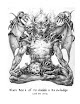
Anonymous - Azazel's Goat (173.0 Kb)
 Book downloads: 450
The Book of Enoch, brings Azazel into connection with the Biblical story of the fall of the angels, located, obviously in accordance with ancient folk-lore, on Mount Hermon as a sort of an old Semitic Blocksberg, a gathering-place of demons from of old (Enoch xiii. compare Brandt, "Mandaische Theologie," 1889, p. 38). Azazel is represented in the Book of Enoch as the leader of the rebellious giants in the time preceding the flood he taught men the art of warfare, of making swords, knives, shields, and coats of mail, ... More >>>Book can be downloaded.
Note that, unfortunately, not all my books can be downloaded due to the restrictions of copyright. However, most of the books on this site do not have copyright restrictions. If you find any copyright violation, please contact me at  . I am very attentive to the issue of copyright and try to avoid any violations, but on the other hand to help all fans of magic to get access to information.
If you are having difficulty downloading books, or you are looking for a book that is not on the site (but maybe it is in my home library), please write me a email to
and I will try to help, I can send the book by e-mail
darkbooks.org began in early 2008 I am happy to donate my time to providing you this resource, I would also like to note, that, although I try, I do not always have enough time to deal with the site, including, unfortunately, I do not always have time to answer all letters, because I have to earn money for a living. If you can financially help me, it would free me from the worries of earning money for living, perhaps partially, but ideally completely, then all 100% of my time could be devoted to the site. Also I do pay monthly web server/files storage and hosting costs to keep this site on the air. Please consider making a donation to help me continue this activity and devote more time to it or at least offset the cost of paying for storage/hosting. Even a small contribution helps!
The Book of Enoch, brings Azazel into connection with the Biblical story of the fall of the angels, located, obviously in accordance with ancient folk-lore, on Mount Hermon as a sort of an old Semitic Blocksberg, a gathering-place of demons from of old (Enoch xiii. compare Brandt, "Mandaische Theologie," 1889, p. 38).
Azazel is represented in the Book of Enoch as the leader of the rebellious giants in the time preceding the flood he taught men the art of warfare, of making swords, knives, shields, and coats of mail, and women the art of deception by ornamenting the body, dyeing the hair, and painting the face and the eyebrows, and also revealed to the people the secrets of witchcraft and corrupted their manners, leading them into wickedness and impurity until at last he was, at the Lord's command, bound hand and foot by the archangel Raphael and chained to the rough and jagged rocks of [Ha] Duduael (= Beth adudo), where he is to abide in utter darkness until the great Day of Judgment, when he will be cast into the fire to be consumed forever (Enoch viii. 1, ix. 6, x. 4-6, liv. 5, lxxxviii. 1 see Geiger, "Jud. Zeit." 1864, pp. 196-204).
The story of Azazel as the seducer of men and women was familiar also to the rabbis, as may be learned from Tanna d. b. R. Yishma'el: "The Azazel goat was to atone for the wicked deeds of 'Uzza and 'Azzael, the leaders of the rebellious hosts in the time of Enoch" (Yoma 67b) and still better from Midrash Abkir, end, Yal., Gen. 44, where Azazel is represented as the seducer of women, teaching them the art of beautifying the body by dye and paint (compare "Chronicles of Jerahmeel," trans. by Gaster, xxv. 13). According to Pir'e R. El. xlvi. (comp. Tos. Meg. 31a), the goat is offered to Azazel as a bribe that he who is identical with Samael or Satan should not by his accusations prevent the atonement of the sins on that day.
About Author:
"Anonymous" of course means "without a name" and is used when the author is not known--or sometimes, when a story develops out of an oral tradition over generations with possibly many storytellers contributing to and revising the tale before it is finally written down and becomes literature.
A notable amount of ancient and medieval literature is anonymous. This is not only due to the lack of documents from a period, but also due to an interpretation of the author's role that differs considerably from the romantic interpretation of the term in use today. Ancient and Medieval authors were often overawed by the classical writers and the Church Fathers and tended to re-tell and embellish stories they had heard or read rather than invent new stories. And even when they did, they often claimed to be handing down something from an auctor instead. From this point of view, the names of the individual authors seemed much less important, and therefore many important works were never attributed to any specific person.