Skip to the archive
Individual books remain freeHelp preserve the shelves
From the archive · John Dee's Books Catalog

Five Books Of Mystery Mysteriorum Liber Secundus

by John Dee

Cover of Five Books Of Mystery Mysteriorum Liber Secundus by John Dee

taken from the archive955times

Theauthor states that no part of the Church of God should be disclosed, emphasizing the sacredness and exclusivity of the mysteries. The passage mentions 'Nothing is cut from the Churche of God. We in his Saincts are blessed for ever. We separate the, from fyled and wycked persons: We move the to God.' This indicates the author's concern with preserving divine secrets and maintaining spiritual purity, highlighting… Read on ›

AuthorAll books of John Dee · Biography · Images
FormateBook, 519.0 Kb
ShelvesEnochian Magic

DarkBooks is a living archive of magical literature, kept since 2008 by its curator and by the readers who support it. Readers have taken 1.9 million books from it — and every one of them stays free. Become one of the keepers ›

About the book

Theauthor states that no part of the Church of God should be disclosed, emphasizing the sacredness and exclusivity of the mysteries. The passage mentions 'Nothing is cut from the Churche of God. We in his Saincts are blessed for ever. We separate the, from fyled and wycked persons: We move the to God.' This indicates the author's concern with preserving divine secrets and maintaining spiritual purity, highlighting the central theme of safeguarding sacred knowledge.

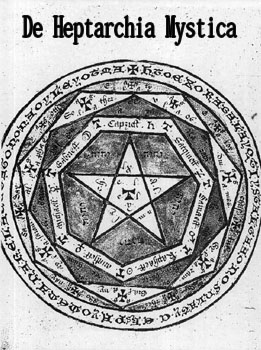
Theauthor describes a divine entity that is simultaneously one and seven, twice three, and seven in whole, emphasizing its multifaceted nature as a name of God. This is illustrated through the mention of seven letters representing the seven seats of God, each containing an angel of brightness and embodying the seven inward powers of God. The author highlights the complexity and mystery of this divine being, which is described as 'one in seven' and 'twice three,' reflecting a deep occult understanding of God's nature through numerical symbolism and angelic representation.

A figure appears with a sword bearing the letter 'H' and the number 22, the author argues. This detail highlights the occult symbolism present in the text, where numerical and alphabetical signs are intertwined with mystical meanings. The author's depiction of such symbols indicates a belief in the interconnectedness of numbers, letters, and spiritual concepts, reflecting the book's focus on mysterious and symbolic elements.

A group of seven young men enters, all dressed in identical white garments, each carrying a distinct metal ball in their hands. One holds a gold ball with a golden tablet inscribed with 'I', another carries a silver ball with a silver tablet marked 'Ih', and the third has a copper ball with a copper tablet bearing 'Ilr'. The author describes their uniform appearance and the symbolic significance of the metals and inscriptions on their tablets, highlighting the ritual's emphasis on divine symbolism and the connection between material elements and spiritual meanings.

After the seven letters are placed, the phrase 'Omnia unum est' is uttered, signifying that all things are one. This reflects the occult claim that the seven letters, when arranged in a specific order, represent a singular, unified divine entity. The author describes a moment where the seven plates, shaped like segments of a circle, seem to take flight and ascend to heaven, reinforcing the idea of unity and divine connection.

Theauthor challenges the common assumption that divine truth is singular and static, presenting a complex, multifaceted deity. The passage 'SIGILLVM DEI ?+M?+TH: EMETH nuncupatum' suggests a divine sigil named Emeth, implying a dynamic and evolving understanding of the divine. This contrasts with traditional views that present God as a fixed, unchanging entity. The author's use of a sigil named Emeth, which means 'truth' in Hebrew, indicates a belief in a truth that is revealed through a process of discovery and interpretation, rather than a direct revelation. This approach challenges the notion of a singular, immutable divine truth, instead proposing a more fluid and layered understanding of the divine.

Not every book of the collection can be downloaded because of copyright, although most of them have no such restrictions. If you find a copyright violation, please write to the curator's email: I am attentive to copyright and try to avoid any violation, while helping all who study magic to reach its literature.

About the author

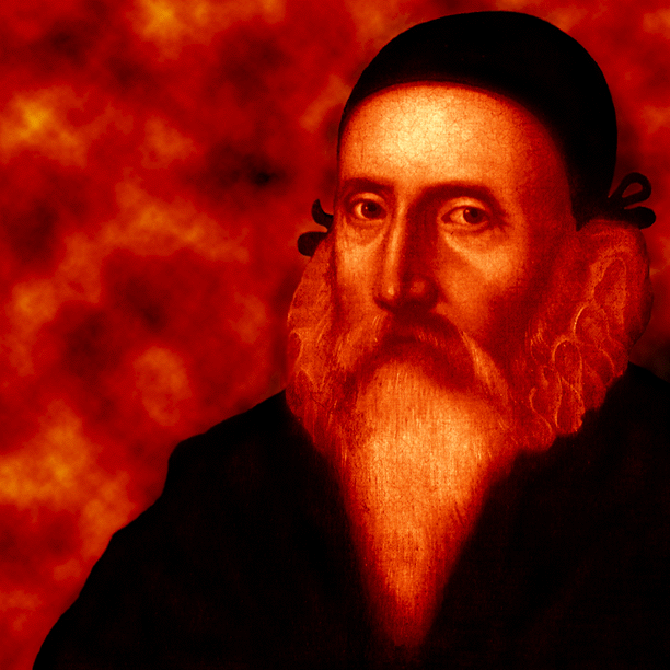
John Dee John Dee (July 13, 1527 - 1608) was a noted British mathematician, astronomer, astrologer, geographer, occultist, and consultant to Queen Elizabeth I. He also devoted much of his life to alchemy, divination, and Hermetic philosophy.

Dee straddled the worlds of science and magic just as they were becoming distinguishable. One of the most learned men of his age, he had been invited to lecture on advanced algebra at the University of Paris while still in his early twenties. Dee was an ardent promoter of mathematics and a respected astronomer, as well as a leading expert in navigation, having trained many of those who would conduct England's voyages of discovery. In one of several tracts which Dee wrote in the 1580s encouraging British exploratory expeditions in search of the Northwest Passage, he appears to have coined the term "British Empire."

Simultaneously with these efforts, Dee immersed himself in the worlds of magic, astrology, and Hermetic philosophy. He devoted much time and effort in the last thirty years or so of his life to attempting to commune with angels in order to learn the universal language of creation. A student of the Renaissance Neo-Platonism of Marsilio Ficino, Dee did not draw distinctions between his mathematical research and his investigations into Hermetic magic and divination, instead considering both ventures to constitute different facets of the same quest: the search for a transcendent understanding of the divine forms which underlie the visible world.

Dee's status as a respected scholar also allowed him to play a role in Elizabethan politics. He served as an occasional adviser and tutor to Elizabeth I and nurtured relationships with her two leading ministers, Francis Walsingham and William Cecil.

In his lifetime Dee amassed the largest library in England and one of the largest in Europe.
Christina DebesCurated by Christina Debes since 2008
KEEP THE LIBRARY FREE

Choose the kind of support that works for you

Individual public-domain books remain free. Paid options provide convenient ZIP archives and help cover hosting, storage, research and preservation.

ONE-TIME

Starter Archive

$12

The Magic Catalog #1 in one curated ZIP file. A simple way to try the archive format.

Get the starter archive
ONGOING SUPPORT

Become a Member

from $5/month

Choose Library Keeper, Archivist or Grand Curator for updates, archive access and a voice in future collections.

See membership levels

Prefer individual books? Continue browsing and downloading them free of charge. Membership is support, not a paywall for the public library.

Make a direct cryptocurrency donation
Bitcoin (BTC network)15Kz1Zuq9FHugjCc3Xamdikdu6irQUHdqG
Ethereum (ETH / ERC-20)0x90c9d66cd07efa5c413551cfd5c2ce03c986b143
The same shelf

More books beside this one

Most taken from the archive
  • 50 Of The Most Powerful Spells On The Face Of Earth
  • Basic Techniques of Sex Magick
  • Book Of Spells
  • Black Book of Forbidden Knowledge Lucid Dreaming
  • The Book Of Shadows
  • The Book Of Secrets
  • Control of The Astral Body
  • White Magic Spells
  • The Book Of Raziel The Angel Or Sefer Raziel HaMalakh
  • The Book Of Thoth
  • Magick In Theory And Practice
  • The Darkside Of The Moon A Complete Course In Magic And Witchcraft

Looking for a book that is not here? It may be in my home library: write to the curator's email and I will try to help — I can send the book by email.