Skip to the archive
Individual books remain freeHelp preserve the shelves
From the archive · Howard Phillips Lovecraft Books Catalog

Dreams in the Witch House

by Howard Phillips Lovecraft

Cover of Dreams in the Witch House by Howard Phillips Lovecraft

taken from the archive365times

Theauthor describes a gaoler who went mad and spoke of a small white-fanged furry thing escaping from Keziah Mason's cell in 1692. This detail highlights the bizarre and unexplained events tied to the historical figure of Keziah Mason, suggesting that the gaoler's madness was influenced by something supernatural, as the creature fled the cell and left red, sticky fluid on the walls. The passage implies that the… Read on ›

AuthorAll books of Howard Phillips Lovecraft · Biography · Images
FormateBook, 219.0 Kb
ShelvesHorror Tales

The whole Howard Phillips Lovecraft Books Catalog in one ZIP

DarkBooks is a living archive of magical literature, kept since 2008 by its curator and by the readers who support it. Readers have taken 1.9 million books from it — and every one of them stays free. Become one of the keepers ›

About the book

Theauthor describes a gaoler who went mad and spoke of a small white-fanged furry thing escaping from Keziah Mason's cell in 1692. This detail highlights the bizarre and unexplained events tied to the historical figure of Keziah Mason, suggesting that the gaoler's madness was influenced by something supernatural, as the creature fled the cell and left red, sticky fluid on the walls. The passage implies that the events surrounding Keziah Mason are not fully explained by conventional means, adding to the eerie and mysterious atmosphere of the town of Arkham.

A dreamlike figure with a spiky, metallic surface appears in both waking life and sleep, the author describes. This object, with its ridged barrel-shaped center, thin radiating arms, knobs, and starfish-like arms, is a key element in the narrative. The figure, which Gilman breaks off from a balustrade in his dream, later reappears in his home, lying on its side with no detail missing. The figure's iridescent grey color veined with green and the jagged break at one of its knobs serve as concrete details that emphasize its otherworldly origin and the eerie fusion of dream and reality.

Walter Gilman, a lodger in the Witch-House, becomes the victim of an enigmatic and unexplained death linked to his bizarre dreams. The author describes how Gilman's body is found with a tunnel through his body, suggesting something had eaten his heart out. The mystery deepens as the house is never rented again and is eventually condemned, with locals avoiding it due to its old reputation and a persistent foul odor. The author leaves the cause of Gilman's death and the nature of his dreams unresolved, highlighting the eerie and unsettling atmosphere of the house and the lingering spectral gossip in the town.

Walter Gilman experiences a bizarre form of movement in his dreams, where he does not walk, climb, or swim, yet feels a mix of voluntary and involuntary motion. This strange sensation is part of his surreal dream world, where his physical form is distorted and his surroundings are filled with alien-hued, indescribably angled masses. The dream environment is both menacing and incomprehensible, with organic and inorganic objects that evoke vague memories and unsettling sensations. Gilman's dreams often feature the terrifying figure of Brown Jenkin, a small, monstrous creature with long, sharp teeth, which appears in his lighter dreams before he falls into deeper sleep. These dreams reflect his growing anxiety and the influence of the old house on his mind, blending reality and fantasy in a way that is both unsettling and mysterious.

In the dim light of the Witch-House, the enigmatic spiky image continues to haunt the halls of Miskatonic University, its origins and nature forever elusive. The author describes a strange metallic object, discovered by Walter Gilman, which defies classification and sparks intense scientific curiosity. Despite efforts by scholars to unravel its mysteries, the image remains an unresolved enigma, a testament to the unknown forces that lie beyond the reach of conventional understanding. The author's account highlights the persistent fascination with the object, which is now on display, yet its true nature and purpose remain shrouded in mystery, challenging the boundaries of science and the unknown.

Not every book of the collection can be downloaded because of copyright, although most of them have no such restrictions. If you find a copyright violation, please write to the curator's email: I am attentive to copyright and try to avoid any violation, while helping all who study magic to reach its literature.

About the author

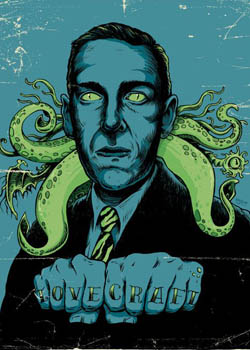
Howard Phillips Lovecraft Howard Phillips Lovecraft (August 20, 1890 - March 15, 1937) was an American author of horror, fantasy, and science fiction, known then simply as weird fiction.

HP Lovecraft was one of the early exponents of horror fantasy, best known for the series of works known collectively as the Cthulhu Mythos. He peppered his books with references to an occult work called The Necronomicon, and, as his fame grew, he was besieged by readers asking where they could find a copy of it. But the truth was that Lovecraft had invented the book and its title. He wrote in a letter of 1937: 'The name Necronomicon (necros, corpse; nomos, law; eikon, image = An Image of the Law of the Dead) occurred to me in the course of a dream, although the etymology is perfectly sound.' So the title came before everything else, and substituted, perfectly reasonably, for the work itself.

This is a game that many writers have played, and the history of literature is full of references to books that don't, in fact, exist. Margaret Atwood, AS Byatt, Dorothy L Sayers, Frank Herbert, Martin Amis, Arthur Conan Doyle and many, many others have all joined in. Some of my favourite fictional titles are from Kurt Vonnegut, who, as Kilgore Trout, writes non-existent works such as The Barring-Gaffner of Bagnialto, or This Year's Masterpiece, which are usually accompanied by helpful plot summaries. Perhaps the most notorious fictional-book-inventors have been writers such as Umberto Eco and Jorge Luis Borges; naturally enough, since their writing often draws attention to literature as itself an artefact.

With the Necronomicon there was a difference, however. Other writers began to treat it as if it really did exist, quoting from the nonexistent work and even composing large sections of it; several Necronomicons were in fact later published, by hoaxers including L. Sprague De Camp and Colin Wilson.

Lovecraft's major inspiration and invention was cosmic horror, the idea that life is incomprehensible to human minds and that the universe is fundamentally alien. Those who genuinely reason, like his protagonists, gamble with sanity. Lovecraft has developed a cult following for his Cthulhu Mythos, a series of loosely interconnected fiction featuring a pantheon of human-nullifying entities, as well as the Necronomicon, a fictional grimoire of magical rites and forbidden lore. His works were deeply pessimistic and cynical, challenging the values of the Enlightenment, Romanticism, and Christian humanism. Lovecraft's protagonists usually achieve the mirror-opposite of traditional gnosis and mysticism by momentarily glimpsing the horror of ultimate reality.

Although Lovecraft's readership was limited during his life, his reputation has grown over the decades, and he is now commonly regarded as one of the most influential horror writers of the 20th century, who together with Edgar Allan Poe has exerted "an incalculable influence on succeeding generations of writers of horror fiction". Stephen King has called Lovecraft "the twentieth century's greatest practitioner of the classic horror tale.
Christina DebesCurated by Christina Debes since 2008
KEEP THE LIBRARY FREE

Choose the kind of support that works for you

Individual public-domain books remain free. Paid options provide convenient ZIP archives and help cover hosting, storage, research and preservation.

ONE-TIME

Starter Archive

$12

The Magic Catalog #1 in one curated ZIP file. A simple way to try the archive format.

Get the starter archive
ONGOING SUPPORT

Become a Member

from $5/month

Choose Library Keeper, Archivist or Grand Curator for updates, archive access and a voice in future collections.

See membership levels

Prefer individual books? Continue browsing and downloading them free of charge. Membership is support, not a paywall for the public library.

Make a direct cryptocurrency donation
Bitcoin (BTC network)15Kz1Zuq9FHugjCc3Xamdikdu6irQUHdqG
Ethereum (ETH / ERC-20)0x90c9d66cd07efa5c413551cfd5c2ce03c986b143
The same shelf

More books beside this one

Most taken from the archive
  • 50 Of The Most Powerful Spells On The Face Of Earth
  • Basic Techniques of Sex Magick
  • Book Of Spells
  • Black Book of Forbidden Knowledge Lucid Dreaming
  • The Book Of Shadows
  • The Book Of Secrets
  • Control of The Astral Body
  • White Magic Spells
  • The Book Of Raziel The Angel Or Sefer Raziel HaMalakh
  • The Book Of Thoth
  • Magick In Theory And Practice
  • The Darkside Of The Moon A Complete Course In Magic And Witchcraft

Looking for a book that is not here? It may be in my home library: write to the curator's email and I will try to help — I can send the book by email.