Skip to the archive
Individual books remain freeHelp preserve the shelves
From the archive · Howard Phillips Lovecraft Books Catalog

The Music of Erich Zann

by Howard Phillips Lovecraft

Cover of The Music of Erich Zann by Howard Phillips Lovecraft

taken from the archive200times

In the early 20th century, a scholar attempts to locate a mysterious street in a French city, the Rue d??(TM)Auseil, where he once heard the music of Erich Zann. The author describes his exhaustive efforts to find the street, including examining ancient maps and exploring the area's antiquities. Despite his meticulous search, he is unable to locate the street, which was once within a half-hour's walk of the… Read on ›

AuthorAll books of Howard Phillips Lovecraft · Biography · Images
FormateBook, 91.0 Kb
ShelvesHorror Tales

The whole Howard Phillips Lovecraft Books Catalog in one ZIP

DarkBooks is a living archive of magical literature, kept since 2008 by its curator and by the readers who support it. Readers have taken 1.9 million books from it — and every one of them stays free. Become one of the keepers ›

About the book

In the early 20th century, a scholar attempts to locate a mysterious street in a French city, the Rue d??(TM)Auseil, where he once heard the music of Erich Zann. The author describes his exhaustive efforts to find the street, including examining ancient maps and exploring the area's antiquities. Despite his meticulous search, he is unable to locate the street, which was once within a half-hour's walk of the university. The Rue d??(TM)Auseil is described as a shadowy, narrow, and steep street bordered by old, leaning houses. The author's inability to find the street is both perplexing and humiliating, as it was a place of significant personal memory and experience.

Erich Zann, a reclusive musician, becomes obsessed with an otherworldly music that grows increasingly erratic and terrifying. His performances, initially mysterious, evolve into a haunting symphony that reflects his inner turmoil and fear. One night, as Zann plays a wild Hungarian dance, he seems to hear a distant, calm, and mocking musical note from the West, which terrifies him. The scene reaches a climax as the window shatters, revealing an infinite, dark void filled with motion and music, devoid of any earthly resemblance. The author describes the unsettling experience of the protagonist, who witnesses Zann's descent into madness and the eerie, unexplained phenomenon that transcends the physical world.

the lone curtained window is especially memorable as it serves as a focal point for the narrative's tension and mystery. The author describes it as the only vantage point from which one could see over the wall at the summit, highlighting its significance in the story's setting. The window is mentioned in the context of Erich Zann's peculiar behavior, as he casts a startled glance toward it, suggesting a deeper, possibly occult, connection to the view beyond. This image encapsulates the isolation and otherworldly nature of Zann's music and his mysterious demeanor, reinforcing the idea that his world lies in a far cosmos of the imagination.

The author notes that despite meticulous searches, the Rue d??(TM)Auseil remains unlocated, a fact that underscores the enigmatic nature of the narrative. This inability to find the street is juxtaposed with the scholar's fascination with Erich Zann's music, which is said to be so intricate and otherworldly that it defies conventional understanding. The passage highlights the disconnect between the physical world and the realm of Zann's compositions, suggesting that the music exists beyond the reach of ordinary perception. The scholar's frustration with the missing street mirrors the broader theme of the book, where the boundaries between reality and the unknown blur, leaving the reader questioning what is real and what is merely imagined.

Theauthor compares the practice of musical composition with the tradition of performance, highlighting the eccentric musician Erich Zann's inability to share his unique harmonies with others. Zann's music, described as a kind of fugue with recurrent passages of captivating quality, is marked by the absence of 'weird notes' he had previously played. However, Zann is unable to perform these specific harmonies for others, indicating a disconnect between his creative process and traditional musical performance. This contrast underscores the novel's exploration of the relationship between artistic creation and the constraints of human interaction, as well as the isolation that can accompany genius.

Not every book of the collection can be downloaded because of copyright, although most of them have no such restrictions. If you find a copyright violation, please write to the curator's email: I am attentive to copyright and try to avoid any violation, while helping all who study magic to reach its literature.

About the author

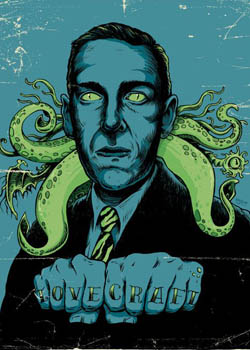
Howard Phillips Lovecraft Howard Phillips Lovecraft (August 20, 1890 - March 15, 1937) was an American author of horror, fantasy, and science fiction, known then simply as weird fiction.

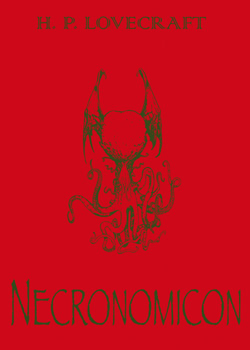
HP Lovecraft was one of the early exponents of horror fantasy, best known for the series of works known collectively as the Cthulhu Mythos. He peppered his books with references to an occult work called The Necronomicon, and, as his fame grew, he was besieged by readers asking where they could find a copy of it. But the truth was that Lovecraft had invented the book and its title. He wrote in a letter of 1937: 'The name Necronomicon (necros, corpse; nomos, law; eikon, image = An Image of the Law of the Dead) occurred to me in the course of a dream, although the etymology is perfectly sound.' So the title came before everything else, and substituted, perfectly reasonably, for the work itself.

This is a game that many writers have played, and the history of literature is full of references to books that don't, in fact, exist. Margaret Atwood, AS Byatt, Dorothy L Sayers, Frank Herbert, Martin Amis, Arthur Conan Doyle and many, many others have all joined in. Some of my favourite fictional titles are from Kurt Vonnegut, who, as Kilgore Trout, writes non-existent works such as The Barring-Gaffner of Bagnialto, or This Year's Masterpiece, which are usually accompanied by helpful plot summaries. Perhaps the most notorious fictional-book-inventors have been writers such as Umberto Eco and Jorge Luis Borges; naturally enough, since their writing often draws attention to literature as itself an artefact.

With the Necronomicon there was a difference, however. Other writers began to treat it as if it really did exist, quoting from the nonexistent work and even composing large sections of it; several Necronomicons were in fact later published, by hoaxers including L. Sprague De Camp and Colin Wilson.

Lovecraft's major inspiration and invention was cosmic horror, the idea that life is incomprehensible to human minds and that the universe is fundamentally alien. Those who genuinely reason, like his protagonists, gamble with sanity. Lovecraft has developed a cult following for his Cthulhu Mythos, a series of loosely interconnected fiction featuring a pantheon of human-nullifying entities, as well as the Necronomicon, a fictional grimoire of magical rites and forbidden lore. His works were deeply pessimistic and cynical, challenging the values of the Enlightenment, Romanticism, and Christian humanism. Lovecraft's protagonists usually achieve the mirror-opposite of traditional gnosis and mysticism by momentarily glimpsing the horror of ultimate reality.

Although Lovecraft's readership was limited during his life, his reputation has grown over the decades, and he is now commonly regarded as one of the most influential horror writers of the 20th century, who together with Edgar Allan Poe has exerted "an incalculable influence on succeeding generations of writers of horror fiction". Stephen King has called Lovecraft "the twentieth century's greatest practitioner of the classic horror tale.
Christina DebesCurated by Christina Debes since 2008
KEEP THE LIBRARY FREE

Choose the kind of support that works for you

Individual public-domain books remain free. Paid options provide convenient ZIP archives and help cover hosting, storage, research and preservation.

ONE-TIME

Starter Archive

$12

The Magic Catalog #1 in one curated ZIP file. A simple way to try the archive format.

Get the starter archive
ONGOING SUPPORT

Become a Member

from $5/month

Choose Library Keeper, Archivist or Grand Curator for updates, archive access and a voice in future collections.

See membership levels

Prefer individual books? Continue browsing and downloading them free of charge. Membership is support, not a paywall for the public library.

Make a direct cryptocurrency donation
Bitcoin (BTC network)15Kz1Zuq9FHugjCc3Xamdikdu6irQUHdqG
Ethereum (ETH / ERC-20)0x90c9d66cd07efa5c413551cfd5c2ce03c986b143
The same shelf

More books beside this one

Most taken from the archive
  • 50 Of The Most Powerful Spells On The Face Of Earth
  • Basic Techniques of Sex Magick
  • Book Of Spells
  • Black Book of Forbidden Knowledge Lucid Dreaming
  • The Book Of Shadows
  • The Book Of Secrets
  • Control of The Astral Body
  • White Magic Spells
  • The Book Of Raziel The Angel Or Sefer Raziel HaMalakh
  • The Book Of Thoth
  • Magick In Theory And Practice
  • The Darkside Of The Moon A Complete Course In Magic And Witchcraft

Looking for a book that is not here? It may be in my home library: write to the curator's email and I will try to help — I can send the book by email.