Skip to the archive
Individual books remain freeHelp preserve the shelves
From the archive · Magic Books Catalog #2

Aspects of Evocation

by Phil Hine

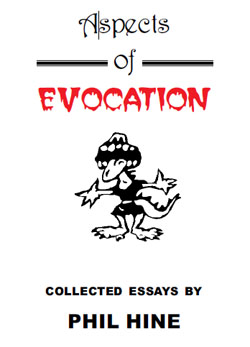
Cover of Aspects of Evocation by Phil Hine

taken from the archive1,491times

The author mentions collaborating with Stephen Sennitt, editor of Nox magazine, which highlights the collaborative nature of the work and the support received from within the esoteric community. This detail underscores the importance of editorial and peer support in the creation and dissemination of occult literature. A talisman made from a circle with two opposite-running arrows is described by the author as the… Read on ›

AuthorAll books of Phil Hine · Biography · Images
FormateBook, 362.0 Kb
ShelvesChaos Magic

The whole Magic Books Catalog #2 in one ZIP

DarkBooks is a living archive of magical literature, kept since 2008 by its curator and by the readers who support it. Readers have taken 1.9 million books from it — and every one of them stays free. Become one of the keepers ›

About the book

The author mentions collaborating with Stephen Sennitt, editor of Nox magazine, which highlights the collaborative nature of the work and the support received from within the esoteric community. This detail underscores the importance of editorial and peer support in the creation and dissemination of occult literature.

A talisman made from a circle with two opposite-running arrows is described by the author as the sigil of Goflowolfog. This image is presented as a key element in the ritual for summoning the spirit, serving both as a focus for evocation and a tool to draw the favor of Goflowolfog. The author argues that this sigil is particularly memorable due to its symbolic representation of movement and direction, reflecting the spirit's role in easing traffic stoppages. The design of the sigil is part of a broader process of creating helpful spirits, where the shape is chosen to be memorable and congruent with the spirit's nature. The author emphasizes the practical application of such symbols in everyday situations, demonstrating how they can be used to enhance one's interaction with the spiritual realm.

two friends of mine who were members of the West Yorkshire Earth Mysteries Group had experienced a strange encounter at the then newly-uncovered Backstone Stone Circle. Their experience included seeing Earth Lights, small dwarf-like shades, and lines of energy around the stone circle that they spent a night sitting in. This encounter led the author to making a more intensive study of Earth Mysteries and Magic, as evidenced by the references to Paul Deveraux, Fra. Choronzon, H.P. Lovecraft, and John Keel.

A pile of psychographs is destroyed in a disturbing episode, leaving the author exhausted and retching on the temple floor, overwhelmed by the emotional intensity of the process. The red lines of the yantracircuit on the floor seem particularly mocking, adding to the unsettling atmosphere. The author experiences a violent emotional release, howling the names that erupt from their throat, and is then engulfed by jackals that wear their face, symbolizing the merging of self with the chaotic forces they are trying to confront.

A toroidal structure with electromagnetic characteristics is proposed as a means of information transfer and storage, suggesting that entities created through ritual might possess such properties. The author suggests that these structures, which can be produced through physiological processes, may underlie the creation of evoked entities, including those associated with Earth Lights and other paranormal phenomena. This idea ties into the broader discussion of how consciousness interacts with the physical world, proposing that entities created through ritual could retain information and evolve beyond their creators. The author also touches on the commonality of experiences in UFO and spectral encounters, implying a deeper connection between human perception and external forces.

Not every book of the collection can be downloaded because of copyright, although most of them have no such restrictions. If you find a copyright violation, please write to the curator's email: I am attentive to copyright and try to avoid any violation, while helping all who study magic to reach its literature.

About the author

Phil Hine Phil Hine is a writer, artist, book reviewer and occultist of Chaos Magick. He is one of the most well known authors and exponents on this subject through his works Pseudonomicon, Condensed Chaos, Prime Chaos, as well as several essays on the topics of chaos magic and Cthulhu Mythos magick.

Phil Hine is widely considered one of the most practical, down-to-earth, and accessible authors on the subject of occultism. Unlike the more complex writings of authors such as Aleister Crowley, his works are considered highly successful at taking the mystical jargon out of magical writing.

Phil Hine repeatedly stresses, probably strongly influenced by Peter Carroll, Robert Anton Wilson and Neuro-linguistic Programming, that the metaphysical frameworks used by certain schools of magic and their attendant goals for the practitioner are not inescapable absolutes, but, to the chaos magician, matters of style and practicality. Rather than giving metaphysical explanations of why something should work, he outlines a few basic techniques for altering states of consciousness, and insists that the only way to find out about magic is to try it yourself. He generally conforms to the opinion that certain forms of magic are executed in a state of gnosis, but does not do so rigidly.

Phil Hine Biography:

Growing up in Blackpool, Hine became involved with chaos magic theory in West Yorkshire in the 1980s. This was after he "picked up the fabled white edition of Liber Null by Peter J. Carroll at Sorcerer's Apprentice." Hine subsequently published a series of booklets on urban shamanism, and a magic primer that has since been titled Condensed Chaos. This book has been described by William S. Burroughs as "the most concise statement of the logic of modern magic."

He was a founder and co-editor of Pagan News in partnership with Rodney Orpheus, and is a former editor and contributor to Ian Read's magazine Chaos International. He has facilitated workshops and seminars on modern magical practice in America and Europe and contributed to a wide range of occult journals, being most active in the period 1986-1996.

As of 1997 he resides in South London.

Hine is bisexual and has written many articles on this topic within occultism.
Books

His earliest popular work was a small pamphlet now called Oven-Ready Chaos (formerly Condensed Chaos, a title that has been appropriated since for one of his full-length books) which outlined a brief and simple "definition" of magic(k), a brief history of the school of practice called chaos magic and an outline of some of its basic approaches, which presented a number of simple techniques.

Condensed Chaos is a full length expansion of this pamphlet focusing on basic techniques and the style of doing magic that has become associated with chaos magic. It was later joined by a second companion volume Prime Chaos, which focused more on the construction and uses of more formalised ritual techniques.


Phil Hine Written works:

Books:

- Prime Chaos, 1993. ISBN 1-56184-137-4
- Condensed Chaos, 1995. ISBN 1-56184-117-X
- The Pseudonomicon 1996. ISBN 1-56184-195-1

Contributions to anthologies:

- Are You Illuminated? in The Book of Lies - the Disinformation Guide to Magick & the Occult 2003
- Foreword, to Chaotopia!: Magick & Ecstasy in the PandaemonAeon, Dave Lee, Attractor 1997
- "Cthulhu Madness" in The Starry Wisdom, Mitchell (ed), 2nd Edition, Creation Press 1996
- Riding the Serpent, in Secrets of Western Tantra, New Falcon Publications, 1996
- "Sexual Magick: A Chaos Perspective", in Sex, Magick, Tantra & Tarot, New Falcon Publications, 1996
- "Responses to Chaos Culture", in Rebels & Devils, Hyatt (ed), New Falcon Publications 1996
- Foreword, to Chaos Ritual, Steve Wilson, Neptune Press 1994
- "Bitter Venoms", in A Taste of Things to Come, Revelations 23 Press, 1991
- "The Physics of Evocation", in The Nox Anthology, Sennitt & Hewitson-May (eds), New World Publishing, 1990
- "Dark Entries", in Starry Wisdom, Pagan News Publications, 1990

Out of print books:

- Walking Between The Worlds: Techniques of Modern Shamanism Vol.1 (1989)
- Two Worlds & In between: Techniques of Modern Shamanism Vol. II (1989)
- Touched By Fire: Techniques of Modern Shamanism Vol. III (1990)
- Starry Wisdom (Collected essays from the Esoteric Order of Dagon, 1990)
- Chaos Servitors: A User Guide (1991)
- Condensed Chaos (original booklet, 1992)

Source: wikipedia
Christina DebesCurated by Christina Debes since 2008
KEEP THE LIBRARY FREE

Choose the kind of support that works for you

Individual public-domain books remain free. Paid options provide convenient ZIP archives and help cover hosting, storage, research and preservation.

ONE-TIME

Starter Archive

$12

The Magic Catalog #1 in one curated ZIP file. A simple way to try the archive format.

Get the starter archive
ONGOING SUPPORT

Become a Member

from $5/month

Choose Library Keeper, Archivist or Grand Curator for updates, archive access and a voice in future collections.

See membership levels

Prefer individual books? Continue browsing and downloading them free of charge. Membership is support, not a paywall for the public library.

Make a direct cryptocurrency donation
Bitcoin (BTC network)15Kz1Zuq9FHugjCc3Xamdikdu6irQUHdqG
Ethereum (ETH / ERC-20)0x90c9d66cd07efa5c413551cfd5c2ce03c986b143
The same shelf

More books beside this one

Most taken from the archive
  • 50 Of The Most Powerful Spells On The Face Of Earth
  • Basic Techniques of Sex Magick
  • Book Of Spells
  • Black Book of Forbidden Knowledge Lucid Dreaming
  • The Book Of Shadows
  • The Book Of Secrets
  • Control of The Astral Body
  • White Magic Spells
  • The Book Of Raziel The Angel Or Sefer Raziel HaMalakh
  • The Book Of Thoth
  • Magick In Theory And Practice
  • The Darkside Of The Moon A Complete Course In Magic And Witchcraft

Looking for a book that is not here? It may be in my home library: write to the curator's email and I will try to help — I can send the book by email.