Skip to the archive
Individual books remain freeHelp preserve the shelves
From the archive · Aleister Crowley's Books Catalog

Liber 081 The Butterfly Net Or Moonchild

by Aleister Crowley

Cover of Liber 081 The Butterfly Net Or Moonchild by Aleister Crowley

taken from the archive1,247times

A Chinese god is depicted as being deeply moved by the beauty of London at night, a fact that surprises due to the city's usual perception as monstrous and misshapen. The author describes how the city's beauty at night is a revelation, highlighting the contrast between its physical appearance and its mystical allure. This is illustrated through the character of James Abbott McNeill Whistler, who perceives London's… Read on ›

AuthorAll books of Aleister Crowley · Biography · Images
FormateBook, 897.0 Kb
ShelvesThelema Magick

The whole Aleister Crowley's Books Catalog in one ZIP

DarkBooks is a living archive of magical literature, kept since 2008 by its curator and by the readers who support it. Readers have taken 1.9 million books from it — and every one of them stays free. Become one of the keepers ›

About the book

A Chinese god is depicted as being deeply moved by the beauty of London at night, a fact that surprises due to the city's usual perception as monstrous and misshapen. The author describes how the city's beauty at night is a revelation, highlighting the contrast between its physical appearance and its mystical allure. This is illustrated through the character of James Abbott McNeill Whistler, who perceives London's nocturnal beauty as a 'fairy tale of delicacy and wistfulness,' contrasting with the city's 'monstrous and misshapen' nature. The passage underscores the unexpected beauty found in the urban landscape, suggesting that the city's true essence lies in its mysterious and enchanting qualities when viewed at night.

Thecentral subject of the book is the cosmic scale of magical forces and their potential to reshape reality. The author argues that the forces Cyril Grey is working to evoke are of immense, almost universal significance, as evidenced by Douglas' realization that these forces are 'cosmic in scope.' This is underscored by the fact that the old Master, Simon Iff, would only intervene for a world-war, highlighting the magnitude of the stakes involved in the magical conflict. The author explores the tension between opposing forces of magic, with Douglas' inability to grasp the unity of all things leading to his downfall, while Simon Iff's use of love as a pure magical force contrasts with the destructive nature of black magic.

A woman on a yacht sways and wallows over her lover, embodying the physical excesses of a society consumed by luxury. The author suggests that the new generation will transcend traditional fears, embracing strength and honor over weakness. The passage reflects on the cyclical nature of history, noting how France, once marked by scandal, becomes a land of revolutionary ideals. The author's view of history is one of inevitable transformation, where the masses, driven by passion, will ultimately triumph over the hypocrisies of governance. The central mystery is whether humanity can rise above its baser instincts to achieve true moral progress, a question underscored by the relentless march of history and the apparent inevitability of conflict and revolution.

The author argues that this 'Thing' represents the chaotic forces of nature that Cyril attempts to control, leading to a series of absurd and dangerous consequences. The passage highlights the tension between Cyril's aggressive approach to magic and the more serene, non-interfering philosophy of the Way of the Tao, which emphasizes doing nothing to maintain balance. The 'Thing in the Garden' serves as a metaphor for the unpredictable and often uncontrollable forces of the universe, illustrating the dangers of hubris and the futility of attempting to dominate natural laws.

In the aftermath of a failed necromantic ritual, the image of Brother Onofrio fades, symbolizing the failure of the attempt to communicate with supernatural forces. The passage describes the ritual's failure, highlighting the tension between human effort and the overwhelming power of the unknown. The author presents the ritual as a significant event, showcasing the struggle against forces beyond comprehension. The fading image of Brother Onofrio reflects the transient nature of such attempts, emphasizing the futility of human endeavors against the vastness of the supernatural. The narrative underscores the theme of human vulnerability in the face of cosmic forces, as the ritual's outcome is ultimately insignificant compared to the enduring mystery of the unknown.

Not every book of the collection can be downloaded because of copyright, although most of them have no such restrictions. If you find a copyright violation, please write to the curator's email: I am attentive to copyright and try to avoid any violation, while helping all who study magic to reach its literature.

About the author

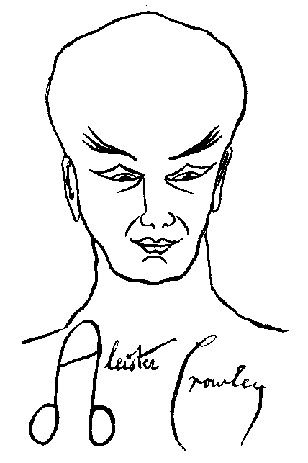
Aleister Crowley Aleister Crowley, born Edward Alexander Crowley, (12 October 1875 - 1 December 1947) was an English occultist, prolific writer and poet, mystic, astrologer, drug experimenter, hedonist, aficionado of chess and mountain climbing, sexual revolutionary and social critic. He is perhaps best known today for his occult writings, especially The Book of the Law, the central sacred text of Thelema. Crowley was also an influential member in several occult organizations, including the Golden Dawn, the Argenteum Astrum, and Ordo Templi Orientis (O.T.O.). Crowley gained much notoriety during his lifetime, and was famously dubbed "The Wickedest Man In the World."

Aleister Crowley founded the religion of Thelema, which became adopted by the Ordo Templis Orientis (O.T.O.) as well as the magical order Argenteum Astrum, the Order of the Silver Star. He was also a highly controversial member of the Hermetic Order of the Golden Dawn, where he was known by the magical name of Frater Perdurabo.

Crowley's lifestyle was absolutely shocking in the era in which he lived. Besides his interest in the occult, he was sexually promiscuous with both genders (at a time when homosexuality was still illegal in Britain), frequented prostitutes, was vocally defiant against Christianity and Victorian and post-Victorian prudishness toward sexual subjects, and was a drug addict.

While Crowley detested Christianity, he considered himself an immensely religious and spiritual person. His writings record incidents of experiencing deity, and Thelemites consider him to be a prophet. In 1904, he encountered a being known as Aiwass, described as a "minister" to Horus, the central deity in Thelema, and as a Holy Guardian Angel. Aiwass dictated the Book of the Law, which Crowley wrote down and published, becoming the central Thelemic text.

Crowley's beliefs included pursuing the Great Work, which included gaining self-knowledge and uniting with the larger universe. He also encouraged seeking out one's ultimate destiny or purpose, commonly referred to as one's True Will.
Christina DebesCurated by Christina Debes since 2008
KEEP THE LIBRARY FREE

Choose the kind of support that works for you

Individual public-domain books remain free. Paid options provide convenient ZIP archives and help cover hosting, storage, research and preservation.

ONE-TIME

Starter Archive

$12

The Magic Catalog #1 in one curated ZIP file. A simple way to try the archive format.

Get the starter archive
ONGOING SUPPORT

Become a Member

from $5/month

Choose Library Keeper, Archivist or Grand Curator for updates, archive access and a voice in future collections.

See membership levels

Prefer individual books? Continue browsing and downloading them free of charge. Membership is support, not a paywall for the public library.

Make a direct cryptocurrency donation
Bitcoin (BTC network)15Kz1Zuq9FHugjCc3Xamdikdu6irQUHdqG
Ethereum (ETH / ERC-20)0x90c9d66cd07efa5c413551cfd5c2ce03c986b143

The same shelf

More books beside this one

Most taken from the archive
  • 50 Of The Most Powerful Spells On The Face Of Earth
  • Basic Techniques of Sex Magick
  • Book Of Spells
  • Black Book of Forbidden Knowledge Lucid Dreaming
  • The Book Of Shadows
  • The Book Of Secrets
  • Control of The Astral Body
  • White Magic Spells
  • The Book Of Raziel The Angel Or Sefer Raziel HaMalakh
  • The Book Of Thoth
  • Magick In Theory And Practice
  • The Darkside Of The Moon A Complete Course In Magic And Witchcraft

Looking for a book that is not here? It may be in my home library: write to the curator's email and I will try to help — I can send the book by email.