Skip to the archive
Individual books remain freeHelp preserve the shelves
From the archive · Aleister Crowley's Books Catalog

The Equinox Vol I No IX

by Aleister Crowley

Cover of The Equinox Vol I No IX by Aleister Crowley

taken from the archive685times

This suggests a central mystery involving the loss of the real key to understanding the ancient mystical knowledge, which was originally derived from Egypt and Chaldea. The author implies that this key has been lost to the general populace, even among those who have been initiated into Freemasonry, highlighting the ongoing quest for this elusive understanding within occult traditions. Theauthorargues that the… Read on ›

AuthorAll books of Aleister Crowley · Biography · Images
FormateBook, 1.6 MB
ShelvesOccult and Esoteric Journals

The whole Aleister Crowley's Books Catalog in one ZIP

DarkBooks is a living archive of magical literature, kept since 2008 by its curator and by the readers who support it. Readers have taken 1.9 million books from it — and every one of them stays free. Become one of the keepers ›

About the book

This suggests a central mystery involving the loss of the real key to understanding the ancient mystical knowledge, which was originally derived from Egypt and Chaldea. The author implies that this key has been lost to the general populace, even among those who have been initiated into Freemasonry, highlighting the ongoing quest for this elusive understanding within occult traditions.

Theauthorargues that the ability to read thoughts through facial expressions is a significant phenomenon, highlighting the intimate and supernatural connection between the characters. The passage describes how Magdalen Blair can perceive her husband's thoughts through subtle facial movements, demonstrating a form of telepathy that is both personal and profound. This ability is not just a fleeting insight but a consistent and reliable skill that enhances their relationship and deepens their understanding of each other. The author presents this as a testament to a deeper, almost mystical connection between individuals, suggesting that such abilities may hold greater significance beyond mere romantic affection.

The author describes how the narrator and his brother learned to write in the style of other authors, including Mr. Jones, Mr. Mummery, and Professor Collie, and then produced their own book in the same manner, making it difficult to distinguish their contributions from those of the original authors. This process of imitation and replication is central to the narrative, illustrating how the duo achieved fame by mastering and reproducing the established literary style.

During a mysterious ritual, the narrator experiences a surreal transformation where they feel detached from their physical body and become a star in a canopy of light. The author describes the narrator's consciousness shifting to a state of infinite space and eventual return to normalcy, yet with a lingering awareness of a deeper truth.

Father Ambrose's ability to discern truth through eye color becomes a central mystery. The author explores how this skill leads to a confrontation when a man's eyes are described as 'a strange dark iridescent purple??"very catlike,' suggesting a supernatural or occult ability to read minds through physical traits. This ability is tested when a man's identity is questioned, and the narrator's insistence on the eyes' authenticity highlights the tension between faith and empirical evidence. The author uses this detail to delve into the intersection of literalism and spiritual revelation, questioning whether the eyes can truly reveal the soul's state.

Theauthor suggests that Mirabelle's allure is tied to a supernatural force, as she warns that she is in danger and that a God exists. This is evident when the character confronts Mirabelle, stating, 'You are in danger, Mirabelle there is a God in heaven after all.' This implies that Mirabelle's presence is not just a matter of beauty but is connected to a higher, possibly divine, power. The author uses this to hint at a deeper mystery surrounding Mirabelle's nature, suggesting that her beauty and influence are not merely physical but are linked to an otherworldly essence.

Not every book of the collection can be downloaded because of copyright, although most of them have no such restrictions. If you find a copyright violation, please write to the curator's email: I am attentive to copyright and try to avoid any violation, while helping all who study magic to reach its literature.

About the author

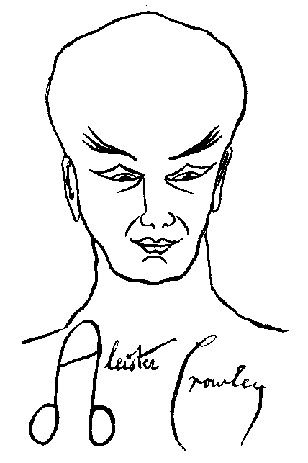
Aleister Crowley Aleister Crowley, born Edward Alexander Crowley, (12 October 1875 - 1 December 1947) was an English occultist, prolific writer and poet, mystic, astrologer, drug experimenter, hedonist, aficionado of chess and mountain climbing, sexual revolutionary and social critic. He is perhaps best known today for his occult writings, especially The Book of the Law, the central sacred text of Thelema. Crowley was also an influential member in several occult organizations, including the Golden Dawn, the Argenteum Astrum, and Ordo Templi Orientis (O.T.O.). Crowley gained much notoriety during his lifetime, and was famously dubbed "The Wickedest Man In the World."

Aleister Crowley founded the religion of Thelema, which became adopted by the Ordo Templis Orientis (O.T.O.) as well as the magical order Argenteum Astrum, the Order of the Silver Star. He was also a highly controversial member of the Hermetic Order of the Golden Dawn, where he was known by the magical name of Frater Perdurabo.

Crowley's lifestyle was absolutely shocking in the era in which he lived. Besides his interest in the occult, he was sexually promiscuous with both genders (at a time when homosexuality was still illegal in Britain), frequented prostitutes, was vocally defiant against Christianity and Victorian and post-Victorian prudishness toward sexual subjects, and was a drug addict.

While Crowley detested Christianity, he considered himself an immensely religious and spiritual person. His writings record incidents of experiencing deity, and Thelemites consider him to be a prophet. In 1904, he encountered a being known as Aiwass, described as a "minister" to Horus, the central deity in Thelema, and as a Holy Guardian Angel. Aiwass dictated the Book of the Law, which Crowley wrote down and published, becoming the central Thelemic text.

Crowley's beliefs included pursuing the Great Work, which included gaining self-knowledge and uniting with the larger universe. He also encouraged seeking out one's ultimate destiny or purpose, commonly referred to as one's True Will.
Christina DebesCurated by Christina Debes since 2008
KEEP THE LIBRARY FREE

Choose the kind of support that works for you

Individual public-domain books remain free. Paid options provide convenient ZIP archives and help cover hosting, storage, research and preservation.

ONE-TIME

Starter Archive

$12

The Magic Catalog #1 in one curated ZIP file. A simple way to try the archive format.

Get the starter archive
ONGOING SUPPORT

Become a Member

from $5/month

Choose Library Keeper, Archivist or Grand Curator for updates, archive access and a voice in future collections.

See membership levels

Prefer individual books? Continue browsing and downloading them free of charge. Membership is support, not a paywall for the public library.

Make a direct cryptocurrency donation
Bitcoin (BTC network)15Kz1Zuq9FHugjCc3Xamdikdu6irQUHdqG
Ethereum (ETH / ERC-20)0x90c9d66cd07efa5c413551cfd5c2ce03c986b143

The same shelf

More books beside this one

Most taken from the archive
  • 50 Of The Most Powerful Spells On The Face Of Earth
  • Basic Techniques of Sex Magick
  • Book Of Spells
  • Black Book of Forbidden Knowledge Lucid Dreaming
  • The Book Of Shadows
  • The Book Of Secrets
  • Control of The Astral Body
  • White Magic Spells
  • The Book Of Raziel The Angel Or Sefer Raziel HaMalakh
  • The Book Of Thoth
  • Magick In Theory And Practice
  • The Darkside Of The Moon A Complete Course In Magic And Witchcraft

Looking for a book that is not here? It may be in my home library: write to the curator's email and I will try to help — I can send the book by email.