Skip to the archive
Individual books remain freeHelp preserve the shelves
From the archive · Howard Phillips Lovecraft Books Catalog

Cults Of Cthulhu

by Howard Phillips Lovecraft

Cover of Cults Of Cthulhu by Howard Phillips Lovecraft

taken from the archive394times

H. P. Lovecraft's dream-world experiences allowed him glimpses of places and entities beyond the world of mundane reality, revealing a hidden cosmic order that challenges human understanding. The author suggests that even death may not be permanent, as evidenced by the line 'That is not dead which can eternal lie,' implying that some aspects of existence may transcend conventional notions of life and death, hinting… Read on ›

AuthorAll books of Howard Phillips Lovecraft · Biography · Images
FormateBook, 297.0 Kb
ShelvesHorror Tales

The whole Howard Phillips Lovecraft Books Catalog in one ZIP

DarkBooks is a living archive of magical literature, kept since 2008 by its curator and by the readers who support it. Readers have taken 1.9 million books from it — and every one of them stays free. Become one of the keepers ›

About the book

H. P. Lovecraft's dream-world experiences allowed him glimpses of places and entities beyond the world of mundane reality, revealing a hidden cosmic order that challenges human understanding. The author suggests that even death may not be permanent, as evidenced by the line 'That is not dead which can eternal lie,' implying that some aspects of existence may transcend conventional notions of life and death, hinting at a deeper, unknowable reality that defies human comprehension.

In 1975, the Cult of the Deep Ones practiced a ritual at a deserted lake in Wisconsin, immersing themselves in ice-cold water to facilitate a transfer of sex-magical energy between priests and priestesses. The author notes that this ritual aimed to make contact with the Deep Ones, which 'assume an almost tangible substance.' This occult practice, described in the text, highlights the intersection of the Cthulhu Mythos with real-world magical traditions, showcasing how elements from Lovecraft's fiction have been adopted by modern practitioners.

The author explores the philosophical underpinnings of Lovecraft's cosmic horror, emphasizing the ideological contrast between his view of ancient gods as evil and Aleister Crowley's Thelemic perspective, which sees their return as part of a cosmic progression. The author highlights the complex pantheon of deities in the Cthulhu Mythos, noting that Lovecraft's depiction of Yog-Sothoth as the gatekeeper of the cosmos reflects a mystical framework akin to Hindu philosophy, where Yog-Sothoth embodies the infinite and serves as a bridge between dimensions.

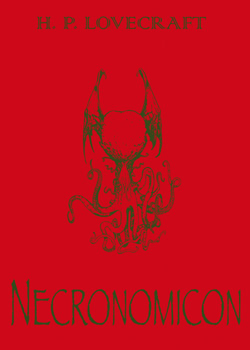
In 1936, Lovecraft outlined the Necronomicon's history, noting it was banned by Pope Gregory IX. The book, created by the mad Arab Abdul Alhazred, was transcribed in 730 A.D. and later translated into Greek and Latin. The author details its suppression by religious authorities, including its ban by the Pope, and its hidden existence in various collections. The text's history reflects the tension between knowledge and power, as it was deemed dangerous and forbidden. The author's account highlights the occult and historical claims surrounding the book, including its alleged origins and translations, and its role in the broader context of the Cthulhu Mythos.

In 1921, Lovecraft described experiencing a nightmare so vivid and horrifying that he wrote it down automatically, believing it to be a phantasm of his own. The author notes that Lovecraft, despite denying the existence of occult phenomena, wrote about them with subjective certainty, indicating a conflict between his rational and intuitive sides. This is evident in his account of a nightmare where he was drawn into an abyss and felt the presence of the hideous unknown, which he later transcribed into his prose-poem, 'Nyarlathotep'.

In 1936, Lovecraft's depiction of Shub-Niggurath, the author notes, highlights the shared cry 'Ai!' with Aleister Crowley's 'Hymn to Pan'. Shub-Niggurath' as a link between Crowley's poetic invocation and Lovecraft's mythological figure. This suggests a possible influence of Crowley's work on Lovecraft's cosmic mythology, despite limited direct contact. The exclamation 'Io Pan!' from Crowley's poem mirrors the call 'Ai! Shub-Niggurath' in Lovecraft's stories, indicating a thematic and possibly cultural resonance between the two figures. This connection underscores the interplay between occult philosophy and literary imagination in the development of Lovecraft's mythos.

Not every book of the collection can be downloaded because of copyright, although most of them have no such restrictions. If you find a copyright violation, please write to the curator's email: I am attentive to copyright and try to avoid any violation, while helping all who study magic to reach its literature.

About the author

Howard Phillips Lovecraft Howard Phillips Lovecraft (August 20, 1890 - March 15, 1937) was an American author of horror, fantasy, and science fiction, known then simply as weird fiction.

HP Lovecraft was one of the early exponents of horror fantasy, best known for the series of works known collectively as the Cthulhu Mythos. He peppered his books with references to an occult work called The Necronomicon, and, as his fame grew, he was besieged by readers asking where they could find a copy of it. But the truth was that Lovecraft had invented the book and its title. He wrote in a letter of 1937: 'The name Necronomicon (necros, corpse; nomos, law; eikon, image = An Image of the Law of the Dead) occurred to me in the course of a dream, although the etymology is perfectly sound.' So the title came before everything else, and substituted, perfectly reasonably, for the work itself.

This is a game that many writers have played, and the history of literature is full of references to books that don't, in fact, exist. Margaret Atwood, AS Byatt, Dorothy L Sayers, Frank Herbert, Martin Amis, Arthur Conan Doyle and many, many others have all joined in. Some of my favourite fictional titles are from Kurt Vonnegut, who, as Kilgore Trout, writes non-existent works such as The Barring-Gaffner of Bagnialto, or This Year's Masterpiece, which are usually accompanied by helpful plot summaries. Perhaps the most notorious fictional-book-inventors have been writers such as Umberto Eco and Jorge Luis Borges; naturally enough, since their writing often draws attention to literature as itself an artefact.

With the Necronomicon there was a difference, however. Other writers began to treat it as if it really did exist, quoting from the nonexistent work and even composing large sections of it; several Necronomicons were in fact later published, by hoaxers including L. Sprague De Camp and Colin Wilson.

Lovecraft's major inspiration and invention was cosmic horror, the idea that life is incomprehensible to human minds and that the universe is fundamentally alien. Those who genuinely reason, like his protagonists, gamble with sanity. Lovecraft has developed a cult following for his Cthulhu Mythos, a series of loosely interconnected fiction featuring a pantheon of human-nullifying entities, as well as the Necronomicon, a fictional grimoire of magical rites and forbidden lore. His works were deeply pessimistic and cynical, challenging the values of the Enlightenment, Romanticism, and Christian humanism. Lovecraft's protagonists usually achieve the mirror-opposite of traditional gnosis and mysticism by momentarily glimpsing the horror of ultimate reality.

Although Lovecraft's readership was limited during his life, his reputation has grown over the decades, and he is now commonly regarded as one of the most influential horror writers of the 20th century, who together with Edgar Allan Poe has exerted "an incalculable influence on succeeding generations of writers of horror fiction". Stephen King has called Lovecraft "the twentieth century's greatest practitioner of the classic horror tale.
Christina DebesCurated by Christina Debes since 2008
KEEP THE LIBRARY FREE

Choose the kind of support that works for you

Individual public-domain books remain free. Paid options provide convenient ZIP archives and help cover hosting, storage, research and preservation.

ONE-TIME

Starter Archive

$12

The Magic Catalog #1 in one curated ZIP file. A simple way to try the archive format.

Get the starter archive
ONGOING SUPPORT

Become a Member

from $5/month

Choose Library Keeper, Archivist or Grand Curator for updates, archive access and a voice in future collections.

See membership levels

Prefer individual books? Continue browsing and downloading them free of charge. Membership is support, not a paywall for the public library.

Make a direct cryptocurrency donation
Bitcoin (BTC network)15Kz1Zuq9FHugjCc3Xamdikdu6irQUHdqG
Ethereum (ETH / ERC-20)0x90c9d66cd07efa5c413551cfd5c2ce03c986b143
The same shelf

More books beside this one

Most taken from the archive
  • 50 Of The Most Powerful Spells On The Face Of Earth
  • Basic Techniques of Sex Magick
  • Book Of Spells
  • Black Book of Forbidden Knowledge Lucid Dreaming
  • The Book Of Shadows
  • The Book Of Secrets
  • Control of The Astral Body
  • White Magic Spells
  • The Book Of Raziel The Angel Or Sefer Raziel HaMalakh
  • The Book Of Thoth
  • Magick In Theory And Practice
  • The Darkside Of The Moon A Complete Course In Magic And Witchcraft

Looking for a book that is not here? It may be in my home library: write to the curator's email and I will try to help — I can send the book by email.