"The Street" is a short story by American horror fiction writer H. P. Lovecraft, written in late 1919 and first published in the December 1920 issue of the Wolverine amateur journal.
The story traces the history of the eponymous street in a New England city, presumably Boston, from its first beginnings as a path in colonial times to a quasi-supernatural occurrence in the years immediately following World War I.
As the city grows up around the street, it is planted with many trees and built along with "simple, beautiful houses of brick and wood," each with a rose garden. As the Industrial Revolution runs its course, the area degenerates into a run-down, polluted slum, with all of the street's old houses falling into disrepair.
After World War I and the October Revolution, the area becomes home to a community of Russian emigres among the new residents are the leadership of a "vast band of terrorists" who are plotting the destruction of the United States on Independence Day.
When the day arrives, the terrorists gather to do the deed, but before they can get started, all the houses in the street collapse concurrently on top of them, killing them all. Observers at the scene testify that immediately after the collapse, they had visions of the trees and the rose gardens that had once been in the street.
The Boston police strike of September-October 1919 inspired Lovecraft to write "The Street", as he declared in a letter to Frank Belknap Long:
The Boston police mutiny of last year is what prompted that attempt--the magnitude and significance of such an act appalled me. Last fall it was grimly impressive to see Boston without bluecoats, and to watch the musket-bearing State Guardsmen patrolling the streets as though military occupation were in force. They went in pairs, determined-looking and khaki-clad, as if symbols of the strife that lies ahead in civilisation's struggle with the monster of unrest and bolshevism.
The story's anti-immigrant stance echoes such earlier xenophobic poems by Lovecraft as "New England Fallen" and "On a New-England Village Seen by Moonlight".
About the author
Howard Phillips Lovecraft (August 20, 1890 - March 15, 1937) was an American author of horror, fantasy, and science fiction, known then simply as weird fiction.
HP Lovecraft was one of the early exponents of horror fantasy, best known for the series of works known collectively as the Cthulhu Mythos. He peppered his books with references to an occult work called The Necronomicon, and, as his fame grew, he was besieged by readers asking where they could find a copy of it. But the truth was that Lovecraft had invented the book and its title. He wrote in a letter of 1937: 'The name Necronomicon (necros, corpse; nomos, law; eikon, image = An Image of the Law of the Dead) occurred to me in the course of a dream, although the etymology is perfectly sound.' So the title came before everything else, and substituted, perfectly reasonably, for the work itself.
This is a game that many writers have played, and the history of literature is full of references to books that don't, in fact, exist. Margaret Atwood, AS Byatt, Dorothy L Sayers, Frank Herbert, Martin Amis, Arthur Conan Doyle and many, many others have all joined in. Some of my favourite fictional titles are from Kurt Vonnegut, who, as Kilgore Trout, writes non-existent works such as The Barring-Gaffner of Bagnialto, or This Year's Masterpiece, which are usually accompanied by helpful plot summaries. Perhaps the most notorious fictional-book-inventors have been writers such as Umberto Eco and Jorge Luis Borges; naturally enough, since their writing often draws attention to literature as itself an artefact.
With the Necronomicon there was a difference, however. Other writers began to treat it as if it really did exist, quoting from the nonexistent work and even composing large sections of it; several Necronomicons were in fact later published, by hoaxers including L. Sprague De Camp and Colin Wilson.
Lovecraft's major inspiration and invention was cosmic horror, the idea that life is incomprehensible to human minds and that the universe is fundamentally alien. Those who genuinely reason, like his protagonists, gamble with sanity. Lovecraft has developed a cult following for his Cthulhu Mythos, a series of loosely interconnected fiction featuring a pantheon of human-nullifying entities, as well as the Necronomicon, a fictional grimoire of magical rites and forbidden lore. His works were deeply pessimistic and cynical, challenging the values of the Enlightenment, Romanticism, and Christian humanism. Lovecraft's protagonists usually achieve the mirror-opposite of traditional gnosis and mysticism by momentarily glimpsing the horror of ultimate reality.
Although Lovecraft's readership was limited during his life, his reputation has grown over the decades, and he is now commonly regarded as one of the most influential horror writers of the 20th century, who together with Edgar Allan Poe has exerted "an incalculable influence on succeeding generations of writers of horror fiction". Stephen King has called Lovecraft "the twentieth century's greatest practitioner of the classic horror tale.
Not every book of the collection can be downloaded because of copyright, although most of them have no such restrictions. If you find a copyright violation, please write to  : I am attentive to copyright and try to avoid any violation, while helping all who study magic to reach its literature.
 From the archive · Howard Phillips Lovecraft Books Catalog

 Curated by Christina Debes since 2008
 The AlchemistHoward Phillips Lovecraft
 Necronomicon In GermanHoward Phillips Lovecraft
 History Of The NecronomiconHoward Phillips Lovecraft
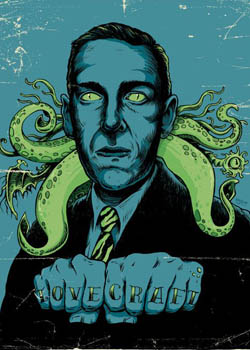 Poetry of the GodsHoward Phillips Lovecraft
 The Call of CthulhuHoward Phillips Lovecraft
 The Crawling ChaosHoward Phillips Lovecraft
 At the Mountains of MadnessHoward Phillips Lovecraft
 Cults Of CthulhuHoward Phillips Lovecraft