Skip to the archive
Individual books remain freeHelp preserve the shelves
From the archive · Aleister Crowley's Books Catalog

The Works Of Aleister Crowley Vol II Part 1

by Aleister Crowley

Cover of The Works Of Aleister Crowley Vol II Part 1 by Aleister Crowley

taken from the archive487times

Thecentral subject of the book is the exploration of spiritual and philosophical themes through a collection of essays, poems, and other writings. The author argues that the works reflect a deep engagement with occult and religious truths, as evidenced by the inclusion of poems like 'ODE TO SAPPHO' and 'HYMN TO APOLLO', which blend mystical imagery with classical references. The book also examines personal and moral… Read on ›

AuthorAll books of Aleister Crowley · Biography · Images
FormateBook, 272.0 Kb
ShelvesThelema Magick

The whole Aleister Crowley's Books Catalog in one ZIP

DarkBooks is a living archive of magical literature, kept since 2008 by its curator and by the readers who support it. Readers have taken 1.9 million books from it — and every one of them stays free. Become one of the keepers ›

About the book

Thecentral subject of the book is the exploration of spiritual and philosophical themes through a collection of essays, poems, and other writings. The author argues that the works reflect a deep engagement with occult and religious truths, as evidenced by the inclusion of poems like 'ODE TO SAPPHO' and 'HYMN TO APOLLO', which blend mystical imagery with classical references. The book also examines personal and moral reflections, such as in 'MY WIFE DIES' and 'THE DEATH OF THE DRUNKARD', illustrating Crowley's views on life, death, and the human condition. The text is annotated with historical context and critical notes, providing insight into the author's intentions and the cultural milieu of the time.

In the coastal setting of Japan, the author grapples with the transient nature of existence, as illustrated by the line 'The pensive period Of night and day beats like a waving fan.' The passage reflects on the fleeting joys and fears of life, emphasizing the inevitability of decay and the search for spiritual transcendence. The author explores the tension between the divine and the human, questioning the purpose of life amidst the relentless cycle of change. This is evident in the meditation on the 'Triads of Despair,' where the speaker contemplates the loss of divine light and the inevitable passage of time. The author examines the occult and philosophical dimensions of existence, portraying a world where beauty and decay coexist, and where the pursuit of spiritual truth is a continuous, often painful journey.

Theauthor describes a surreal encounter with a mythical figure, the Yankee God, who opposes their plans to travel to Japan. This encounter occurs during a moment of emotional turmoil, reflecting the author's internal conflict and the mystical elements woven into the narrative. The passage highlights the tension between human desires and supernatural forces, illustrating the complex interplay of love, spirituality, and the occult as explored in the text.

The author argues that the divine is embodied in a figure who transforms agony into transcendence, as seen in the line 'Thou art the fair, the wise, the divine!' This reflects the text's central mystery: the interplay between destruction and creation, where suffering is not merely endured but revered as a path to higher existence. The passage illustrates this through the worship of a goddess who embodies both torment and renewal, suggesting that the divine is found in the union of flesh and fire, where pain becomes a catalyst for spiritual evolution.

A surly amethyst gleam marks the transition from daylight to night as the Earl faces the unknown. The author describes the Earl encountering a mysterious path leading to a black path towards the water, where Hell is said to be entombed. The passage reveals the Earl's journey into a dark and foreboding landscape, where he confronts the supernatural and the occult. The author's narrative highlights the Earl's spiritual quest and the eerie atmosphere surrounding him, emphasizing the themes of transformation and the supernatural. The passage suggests that the divine is present in the form of a mysterious and ominous force, which the Earl must face on his journey. The author's depiction of the environment reflects the deeper spiritual and philosophical themes explored in the book.

Not every book of the collection can be downloaded because of copyright, although most of them have no such restrictions. If you find a copyright violation, please write to the curator's email: I am attentive to copyright and try to avoid any violation, while helping all who study magic to reach its literature.

About the author

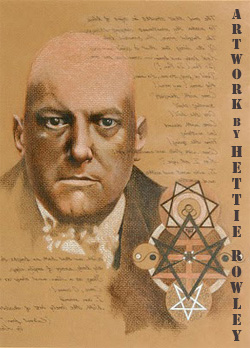
Aleister Crowley Aleister Crowley, born Edward Alexander Crowley, (12 October 1875 - 1 December 1947) was an English occultist, prolific writer and poet, mystic, astrologer, drug experimenter, hedonist, aficionado of chess and mountain climbing, sexual revolutionary and social critic. He is perhaps best known today for his occult writings, especially The Book of the Law, the central sacred text of Thelema. Crowley was also an influential member in several occult organizations, including the Golden Dawn, the Argenteum Astrum, and Ordo Templi Orientis (O.T.O.). Crowley gained much notoriety during his lifetime, and was famously dubbed "The Wickedest Man In the World."

Aleister Crowley founded the religion of Thelema, which became adopted by the Ordo Templis Orientis (O.T.O.) as well as the magical order Argenteum Astrum, the Order of the Silver Star. He was also a highly controversial member of the Hermetic Order of the Golden Dawn, where he was known by the magical name of Frater Perdurabo.

Crowley's lifestyle was absolutely shocking in the era in which he lived. Besides his interest in the occult, he was sexually promiscuous with both genders (at a time when homosexuality was still illegal in Britain), frequented prostitutes, was vocally defiant against Christianity and Victorian and post-Victorian prudishness toward sexual subjects, and was a drug addict.

While Crowley detested Christianity, he considered himself an immensely religious and spiritual person. His writings record incidents of experiencing deity, and Thelemites consider him to be a prophet. In 1904, he encountered a being known as Aiwass, described as a "minister" to Horus, the central deity in Thelema, and as a Holy Guardian Angel. Aiwass dictated the Book of the Law, which Crowley wrote down and published, becoming the central Thelemic text.

Crowley's beliefs included pursuing the Great Work, which included gaining self-knowledge and uniting with the larger universe. He also encouraged seeking out one's ultimate destiny or purpose, commonly referred to as one's True Will.
Christina DebesCurated by Christina Debes since 2008
KEEP THE LIBRARY FREE

Choose the kind of support that works for you

Individual public-domain books remain free. Paid options provide convenient ZIP archives and help cover hosting, storage, research and preservation.

ONE-TIME

Starter Archive

$12

The Magic Catalog #1 in one curated ZIP file. A simple way to try the archive format.

Get the starter archive
ONGOING SUPPORT

Become a Member

from $5/month

Choose Library Keeper, Archivist or Grand Curator for updates, archive access and a voice in future collections.

See membership levels

Prefer individual books? Continue browsing and downloading them free of charge. Membership is support, not a paywall for the public library.

Make a direct cryptocurrency donation
Bitcoin (BTC network)15Kz1Zuq9FHugjCc3Xamdikdu6irQUHdqG
Ethereum (ETH / ERC-20)0x90c9d66cd07efa5c413551cfd5c2ce03c986b143
The same shelf

More books beside this one

Most taken from the archive
  • 50 Of The Most Powerful Spells On The Face Of Earth
  • Basic Techniques of Sex Magick
  • Book Of Spells
  • Black Book of Forbidden Knowledge Lucid Dreaming
  • The Book Of Shadows
  • The Book Of Secrets
  • Control of The Astral Body
  • White Magic Spells
  • The Book Of Raziel The Angel Or Sefer Raziel HaMalakh
  • The Book Of Thoth
  • Magick In Theory And Practice
  • The Darkside Of The Moon A Complete Course In Magic And Witchcraft

Looking for a book that is not here? It may be in my home library: write to the curator's email and I will try to help — I can send the book by email.