Skip to the archive
Individual books remain freeHelp preserve the shelves
From the archive · Howard Phillips Lovecraft Books Catalog

The Haunter of the Dark

by Howard Phillips Lovecraft

Cover of The Haunter of the Dark by Howard Phillips Lovecraft

taken from the archive188times

In 1893, the mysterious death of Robert Blake raises questions about the truth behind his supernatural experiences. The author describes the look of monstrous, transfiguring fear on the face of the young writer when he died, suggesting a deeper, possibly supernatural cause for his demise. Blake's fascination with occult lore and his investigations into local superstitions hint at a connection to the enigmatic events… Read on ›

AuthorAll books of Howard Phillips Lovecraft · Biography · Images
FormateBook, 159.0 Kb
ShelvesHorror Tales

The whole Howard Phillips Lovecraft Books Catalog in one ZIP

DarkBooks is a living archive of magical literature, kept since 2008 by its curator and by the readers who support it. Readers have taken 1.9 million books from it — and every one of them stays free. Become one of the keepers ›

About the book

In 1893, the mysterious death of Robert Blake raises questions about the truth behind his supernatural experiences. The author describes the look of monstrous, transfiguring fear on the face of the young writer when he died, suggesting a deeper, possibly supernatural cause for his demise. Blake's fascination with occult lore and his investigations into local superstitions hint at a connection to the enigmatic events surrounding his death. The author presents conflicting accounts of the church records and the disappearance of a reporter, indicating that Blake's death might be linked to a larger, unresolved mystery involving occult forces. The author suggests that Blake's death could have been the result of a supernatural entity or a hidden truth that was too terrifying to be fully understood.

the author describes a ritual where the thing in the steeple moves into the church during a thunderstorm when lights are out. The thing is said to have moved into the church and caused chaos, including breaking glass in the tower. The thing is described as moving through the darkness and being repelled by light. The author also mentions that the thing in the steeple knows where to find the diarist, Blake, and that Blake feels a constant tugging at his will. The thing is said to have been in the church and tower, causing disturbances and leaving behind traces of its presence, such as stains and a bad odor.

Blake encounters a decaying church with a massive, ominous structure that defies explanation. The building, described as a 'grim, titan bulk,' stands isolated on a plateau, surrounded by overgrown paths and a rusted fence. The church's architecture is in disrepair, with fallen stone buttresses and missing finials, yet its presence exudes an eerie, supernatural aura. The author describes the building as a 'separate, lesser world raised fully six feet above the surrounding streets,' emphasizing its isolation and otherworldly nature. The church is shrouded in mystery, with rumors of a 'monstrous evil' that once dwelled there, and the author suggests that the building's eerie atmosphere may be linked to these ancient tales.

Blake records his frantic attempts to maintain the lights as a crucial factor in his survival, noting the impending threat of darkness. He writes of the supernatural influence permeating the environment, describing how the darkness and lightning create a paradox where light and dark swap identities. His journal entries reveal a growing paranoia as he believes he is being watched by entities in the steeple, which he fears might enter the church through the windowless structure. The author describes Blake's obsession with the steeple and its connection to a hidden, ancient cult, suggesting that the darkness itself is a living entity that can be influenced by human actions.

Blake's experiences challenge the common assumption that the church's abandonment was merely due to natural causes or local superstitions. The author presents the idea that the church is a site of ancient, malevolent rituals, with the steeple serving as a portal for an entity known as the Haunter of the Dark. The author suggests that the church's isolation and the strange phenomena within it are linked to a hidden, supernatural order that seeks to maintain its secrecy and power.

Not every book of the collection can be downloaded because of copyright, although most of them have no such restrictions. If you find a copyright violation, please write to the curator's email: I am attentive to copyright and try to avoid any violation, while helping all who study magic to reach its literature.

About the author

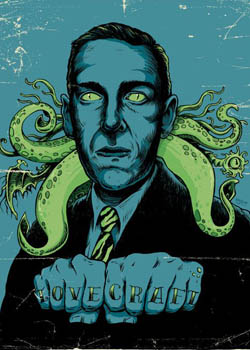
Howard Phillips Lovecraft Howard Phillips Lovecraft (August 20, 1890 ??" March 15, 1937) was an American author of horror, fantasy, and science fiction, known then simply as weird fiction.

HP Lovecraft was one of the early exponents of horror fantasy, best known for the series of works known collectively as the Cthulhu Mythos. He peppered his books with references to an occult work called The Necronomicon, and, as his fame grew, he was besieged by readers asking where they could find a copy of it. But the truth was that Lovecraft had invented the book and its title. He wrote in a letter of 1937: ??The name Necronomicon (necros, corpse; nomos, law; eikon, image = An Image of the Law of the Dead) occurred to me in the course of a dream, although the etymology is perfectly sound.??(TM) So the title came before everything else, and substituted, perfectly reasonably, for the work itself.

This is a game that many writers have played, and the history of literature is full of references to books that don??(TM)t, in fact, exist. Margaret Atwood, AS Byatt, Dorothy L Sayers, Frank Herbert, Martin Amis, Arthur Conan Doyle and many, many others have all joined in. Some of my favourite fictional titles are from Kurt Vonnegut, who, as Kilgore Trout, writes non-existent works such as The Barring-Gaffner of Bagnialto, or This Year's Masterpiece, which are usually accompanied by helpful plot summaries. Perhaps the most notorious fictional-book-inventors have been writers such as Umberto Eco and Jorge Luis Borges; naturally enough, since their writing often draws attention to literature as itself an artefact.

With the Necronomicon there was a difference, however. Other writers began to treat it as if it really did exist, quoting from the nonexistent work and even composing large sections of it; several Necronomicons were in fact later published, by hoaxers including L. Sprague De Camp and Colin Wilson.

Lovecraft's major inspiration and invention was cosmic horror, the idea that life is incomprehensible to human minds and that the universe is fundamentally alien. Those who genuinely reason, like his protagonists, gamble with sanity. Lovecraft has developed a cult following for his Cthulhu Mythos, a series of loosely interconnected fiction featuring a pantheon of human-nullifying entities, as well as the Necronomicon, a fictional grimoire of magical rites and forbidden lore. His works were deeply pessimistic and cynical, challenging the values of the Enlightenment, Romanticism, and Christian humanism. Lovecraft's protagonists usually achieve the mirror-opposite of traditional gnosis and mysticism by momentarily glimpsing the horror of ultimate reality.

Although Lovecraft's readership was limited during his life, his reputation has grown over the decades, and he is now commonly regarded as one of the most influential horror writers of the 20th century, who together with Edgar Allan Poe has exerted "an incalculable influence on succeeding generations of writers of horror fiction". Stephen King has called Lovecraft "the twentieth century's greatest practitioner of the classic horror tale.
Christina DebesCurated by Christina Debes since 2008
KEEP THE LIBRARY FREE

Choose the kind of support that works for you

Individual public-domain books remain free. Paid options provide convenient ZIP archives and help cover hosting, storage, research and preservation.

ONE-TIME

Starter Archive

$12

The Magic Catalog #1 in one curated ZIP file. A simple way to try the archive format.

Get the starter archive
ONGOING SUPPORT

Become a Member

from $5/month

Choose Library Keeper, Archivist or Grand Curator for updates, archive access and a voice in future collections.

See membership levels

Prefer individual books? Continue browsing and downloading them free of charge. Membership is support, not a paywall for the public library.

Make a direct cryptocurrency donation
Bitcoin (BTC network)15Kz1Zuq9FHugjCc3Xamdikdu6irQUHdqG
Ethereum (ETH / ERC-20)0x90c9d66cd07efa5c413551cfd5c2ce03c986b143
The same shelf

More books beside this one

Most taken from the archive
  • 50 Of The Most Powerful Spells On The Face Of Earth
  • Basic Techniques of Sex Magick
  • Book Of Spells
  • Black Book of Forbidden Knowledge Lucid Dreaming
  • The Book Of Shadows
  • The Book Of Secrets
  • Control of The Astral Body
  • White Magic Spells
  • The Book Of Raziel The Angel Or Sefer Raziel HaMalakh
  • The Book Of Thoth
  • Magick In Theory And Practice
  • The Darkside Of The Moon A Complete Course In Magic And Witchcraft

Looking for a book that is not here? It may be in my home library: write to the curator's email and I will try to help — I can send the book by email.